

Should a clothing patch be removable or permanently attached?
The answer depends less on the patch design and more on how the garment will be used.
Choose a removable patch when names, roles, designs, or seasonal identifiers need to change. Choose a permanent attachment when the same patch will stay with the garment through regular wear and washing.
For buyers comparing options, there are four practical attachment categories:
- Hook-and-loop: removable and interchangeable
- Sew-on: long-term, physically stitched attachment
- Iron-on: heat-bonded attachment for compatible garments
- Temporary adhesive: short-term or low-demand use
If you need a full explanation of how each backing is constructed, read the Patch Backing Types Guide. This article focuses specifically on deciding how permanent your clothing patch should be.
Will the Patch Ever Need to Change?
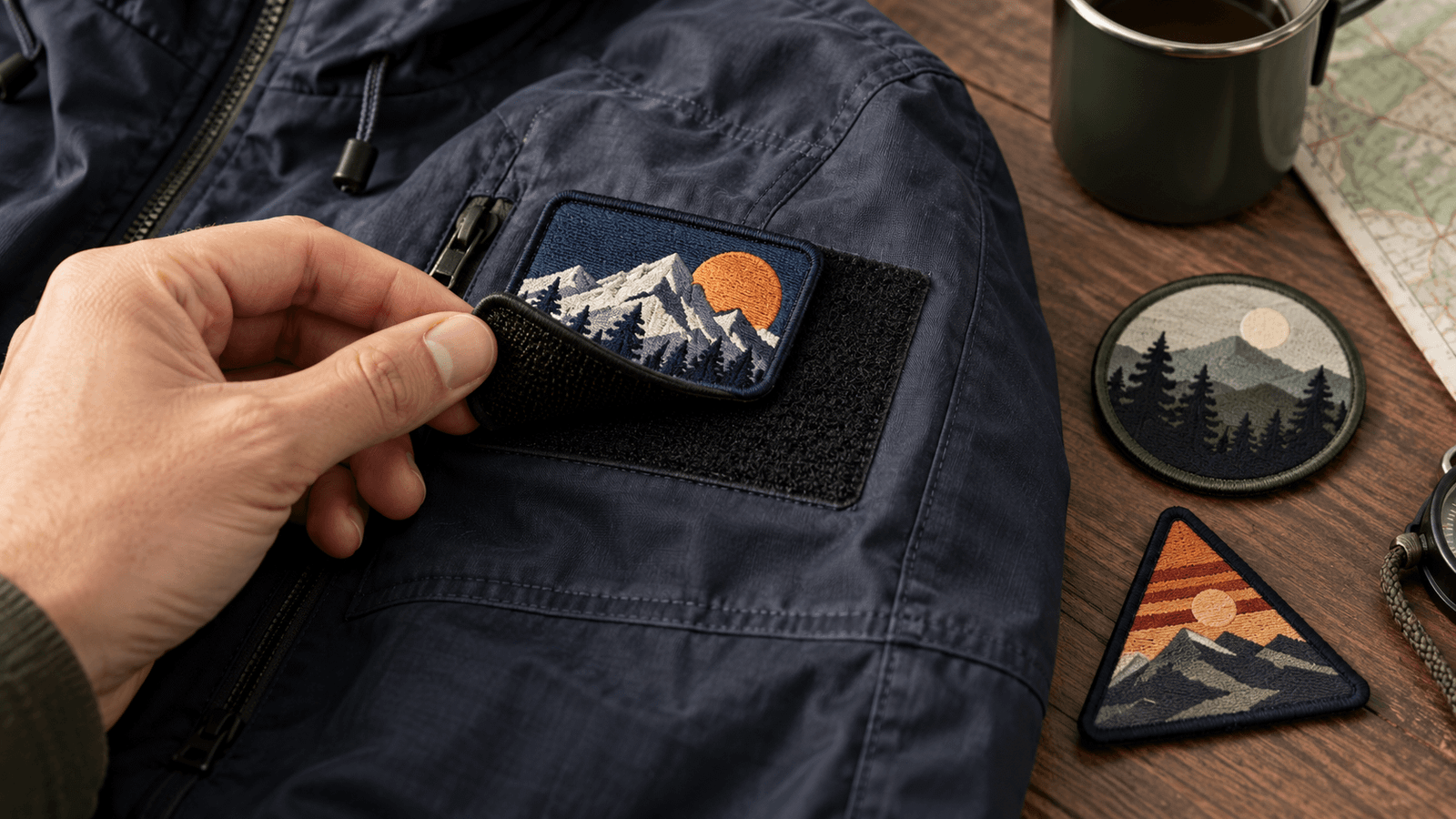
This question often makes the decision easier.
If the patch identifies something that changes regularly, permanent attachment may create unnecessary work.
Examples include:
- Employee names
- Roles
- Departments
- Event identifiers
- Team positions
- Seasonal designs
- Tactical identifiers
- Temporary campaigns
A removable system lets the garment remain in service while the patch changes.
If the patch represents something stable—such as a company logo, school emblem, clothing-brand mark, or permanent club design—a fixed attachment may make more sense.
Quick Comparison: Removable vs Permanent
| Need | Better Direction |
|---|---|
| Patch changes regularly | Hook-and-loop |
| Same patch stays for garment life | Sew-on |
| Quick attachment to compatible fabric | Iron-on |
| Temporary display or short-term use | Adhesive |
| Frequent washing | Secure permanent attachment |
| Uniform names or roles change | Hook-and-loop |
| Garment has no loop panel | Sew-on or compatible iron-on |
| Patch must move between garments | Hook-and-loop |
This is a decision framework, not a universal rule. Garment construction and care instructions still matter.
When Removable Patches Make More Sense
A removable patch is useful when flexibility is part of the garment’s purpose.
Employee and Role Changes
Consider a work jacket used by different employees.
If the name patch is permanently sewn onto the jacket, changing the wearer means removing the old stitching and attaching another patch.
With a compatible hook-and-loop panel, the name can be changed without altering the main garment every time.
This can work well for:
- Names
- Job roles
- Departments
- Shift identifiers
- Temporary assignments
The main company logo can remain permanent while the variable information stays removable.
One Garment, Several Patch Designs
Removable patches also make sense when one garment is intentionally used with different designs.
Examples include:
- Club patches
- Event patches
- Team identifiers
- Morale designs
- Seasonal graphics
- Promotional patches
The clothing becomes the base, while the visible patch changes according to the situation.
That is different from permanently customizing the garment with one fixed design.
When a Permanent Patch Is the Better Choice
Permanent attachment is usually more logical when the patch is part of the garment’s long-term identity.
Examples include:
- Company logos
- School branding
- Team logos
- Jacket back designs
- Streetwear decoration
- Workwear branding
- Club emblems
If there is no practical reason to remove the patch, a permanent attachment avoids adding an interchangeable system that the garment does not need.
Sew-On: Best When the Patch Belongs to the Garment
Sew-on attachment physically connects the patch to the clothing with stitching.
It is a strong choice when:
- The patch should remain on the garment.
- The clothing will be worn regularly.
- The patch is part of the garment design.
- Heat application is unsuitable.
- Washing is an important consideration.
This is particularly useful for:
- Jackets
- Work shirts
- Uniforms
- Denim
- Heavy apparel
Sew-on patches are technically removable if the stitches are carefully taken out, but they should not be treated as interchangeable patches.
Repeatedly sewing and removing patches is different from using a backing designed for regular changes.
Hook-and-Loop: Best for Real Interchangeability
Hook-and-loop is the clearest option when the patch is expected to come off and go back on.
The patch uses a hook surface that connects to a compatible loop field on the garment.
That makes changing patches simple.
It works particularly well when the clothing already includes a loop panel.
Common applications include:
- Uniforms
- Workwear
- Tactical-style clothing
- Jackets
- Hats
- Equipment
The main limitation is equally simple:
The garment needs a compatible loop surface.
If it does not already have one, a loop panel may need to be added.
Iron-On Is Not the Same as Removable
Iron-on patches sometimes create confusion because they can be applied without sewing.
That does not make them a removable patch system.
Iron-on backing uses heat-activated adhesive to bond the patch to compatible fabric.
Once applied, it is normally intended to stay in place rather than being repeatedly attached and removed.
Choose iron-on when:
- Convenient application matters.
- The garment can tolerate the necessary heat.
- The patch is expected to stay in place.
- The application surface is suitable.
Do not choose iron-on if you expect to switch patches regularly.
For a direct comparison of permanent options, see Iron-On vs Sew-On Embroidered Patches.
Temporary Adhesive Is a Different Category
Pressure-sensitive adhesive backing can be useful for situations where permanence is not required.
Possible uses include:
- Temporary display
- Events
- Position testing
- Samples
- Short-term promotional applications
However, clothing creates challenges for simple adhesive attachment.
Fabric:
- Moves
- Folds
- Stretches
- Collects moisture
- Gets washed
- Experiences friction
That makes temporary adhesive different from a true long-term garment attachment.
If the clothing will be worn and washed repeatedly, choose the attachment based on those conditions rather than convenience alone.
Washing Should Influence the Decision
Ask how the garment will be cleaned before selecting the backing.
Frequently Washed Uniforms
If the patch should always stay on the uniform, a secure permanent attachment may be preferable.
Removable Uniform Identifiers
If the patch uses hook-and-loop, removing it before washing may reduce unnecessary friction and wear when appropriate.
Temporary Adhesive
Repeated washing is not the environment where pressure-sensitive adhesive should automatically be expected to perform like a permanent sewn attachment.
Iron-On
Follow the care requirements for both the patch and garment after heat application.
The clothing care label should always be considered.
Think About the Garment’s Lifespan
The useful life of the garment matters too.
Consider three situations.
Long-Term Company Jacket
The company logo will never change.
Likely direction: Permanent attachment.
Shared Work Vest
Different employees may use the vest.
Likely direction: Permanent company logo + removable name patch.
Event Shirt
The patch is needed only for a temporary campaign.
Likely direction: Consider whether a temporary attachment is sufficient for the intended use.
Mixing attachment methods on one garment can sometimes be more practical than forcing everything into one system.
Permanent Logo + Removable Identification
This hybrid approach is especially useful for uniforms.
For example:
Permanent embroidered logo: company identity
Removable name patch: employee identity
Removable role patch: changing assignment
The garment keeps its main branding while variable information can change.
This creates a more flexible system for businesses, teams, clubs, and organizations.
For broader uniform planning, see Uniform Patches: Design and Placement Checklist.
Consider the Garment Material
The same attachment is not appropriate for every textile.
Denim and Heavy Jackets
Structured garments generally provide a stable surface for permanent sewn patches.
Polos and Lightweight Shirts
Patch weight, garment movement, and comfort matter more. Permanent attachment can still work, but the patch should suit the lighter fabric.
Technical or Heat-Sensitive Clothing
Do not assume heat application is safe.
Check the garment care instructions before choosing iron-on backing.
Clothing With Existing Loop Fields
These garments are natural candidates for removable hook-and-loop patches.
For broader garment-specific advice, see the Clothing Patch Guide.
Think About What Happens When the Patch Is Removed
Removal is part of the decision too.
Ask:
Do I want the garment to return to its original condition later?
Different attachment methods can affect the fabric differently.
Sewing can leave stitch holes.
Heat-applied adhesive may leave residue or affect certain materials.
Temporary adhesive can also leave residue depending on the surface and product.
Hook-and-loop requires a loop panel, which itself remains part of the garment.
There is no universal attachment method that becomes completely invisible after removal.
If future removal matters, consider the entire garment system before attaching the patch.
Choose Based on Frequency of Change
A simple way to decide is to classify the patch.
Changes Frequently
Examples:
- Names
- Roles
- Temporary identifiers
- Rotating designs
Consider: Hook-and-loop.
Rarely Changes
Examples:
- Seasonal patch
- Occasional event identifier
Consider: A removable system if reuse matters, or another suitable attachment based on the garment.
Should Never Change
Examples:
- Company logo
- Permanent jacket design
- Clothing-brand patch
Consider: Sew-on or another suitable permanent method.
Needed Only Temporarily
Examples:
- Display
- Sample
- Short promotional use
Consider: Temporary adhesive where the surface and use allow it.
Removable or Permanent Patch Checklist
Before choosing the attachment, ask:
- Will the design ever change?
- Does the patch identify a person or role?
- Will multiple patches use the same garment?
- How often will the clothing be washed?
- Does the garment already have a loop panel?
- Can the fabric safely tolerate heat?
- Does the patch need to survive regular workwear?
- Will the patch move between garments?
- Does removal need to be easy?
- Is the patch temporary, seasonal, or permanent?
Your answers usually make the right direction much clearer.
Choose the Attachment Around Real Use
Removable patches are best when change is expected.
Permanent patches are best when consistency is expected.
Hook-and-loop provides true interchangeability. Sew-on makes sense for patches intended to remain part of the garment. Iron-on provides convenient permanent-style attachment for suitable heat-safe fabrics. Temporary adhesive is better treated as a short-term option rather than a substitute for secure attachment on frequently worn clothing.
Start with the garment and how it will be used, then choose the patch backing.
Explore Custom Clothing Patches and request a free quote with your artwork, garment type, preferred patch size, quantity, and whether you want the patch removable or permanent.
Frequently Asked Questions
What is the best removable patch backing for clothing?
Hook-and-loop is designed for removable and interchangeable patches when the garment has a compatible loop surface.
Are sew-on patches permanent?
Sew-on patches are intended for long-term attachment, although the stitches can usually be removed carefully. They are not as convenient for frequent changes as hook-and-loop patches.
Can iron-on patches be removed and reused?
Iron-on patches are not designed as an interchangeable system. Removing a heat-bonded patch may affect the adhesive or garment, so use hook-and-loop when repeated removal is required.
Are adhesive patches good for clothing?
Adhesive backing can work for temporary or low-demand applications, but fabric movement, washing, moisture, and friction can make it less suitable for long-term garment use.
Should uniform patches be removable?
It depends on the information. A permanent company logo may be appropriate, while changing names, roles, departments, or identifiers may benefit from removable attachment.
What attachment is best for frequently washed clothes?
When a patch must remain permanently attached through regular garment use, a secure permanent method such as sewing may be appropriate. Always consider the garment and patch care requirements.
