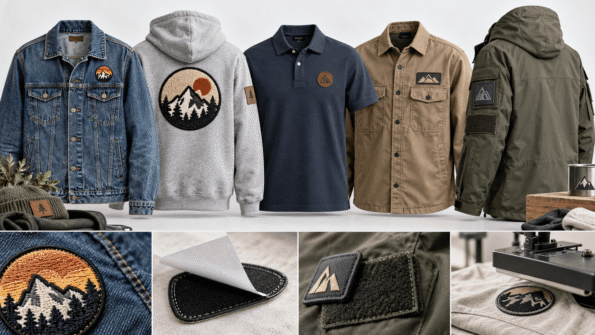
Clothing patches can do much more than cover a tear or add decoration. They can identify a company, represent a team, personalize a jacket, turn ordinary apparel into branded merchandise, or become part of a clothing collection.
The key is choosing a patch that works with the garment.
A patch for a denim jacket may need a different material, size, placement, and attachment method than a patch for a polo shirt, work uniform, varsity jacket, hoodie, or outdoor garment.
In this clothing patch guide, we’ll explain the main types of patches for clothing, where patches can be placed, how different attachment methods work, and what to consider before adding a patch to your apparel.
If you already know the type of garment you want to customize, explore Custom Clothing Patches for shirts, jackets, uniforms, workwear, sportswear, and branded apparel.
What Are Clothing Patches?
Clothing patches are decorative, branded, functional, or identification pieces designed to be attached to garments.
They can feature:
- Company logos
- Names and job titles
- Team logos and mascots
- School or club emblems
- Artwork and illustrations
- Brand marks
- Numbers and lettering
- Event designs
- Achievement badges
- Decorative graphics
Custom clothing patches can be produced in different materials, shapes, sizes, colors, borders, and backing styles depending on how the finished garment will be used.
They are commonly added to jackets, shirts, polos, uniforms, hoodies, workwear, sportswear, streetwear, denim, varsity jackets, and other apparel.
You can also explore all Custom Patches to compare available materials, finishes, and customization options.
Quick Guide to Choosing a Clothing Patch
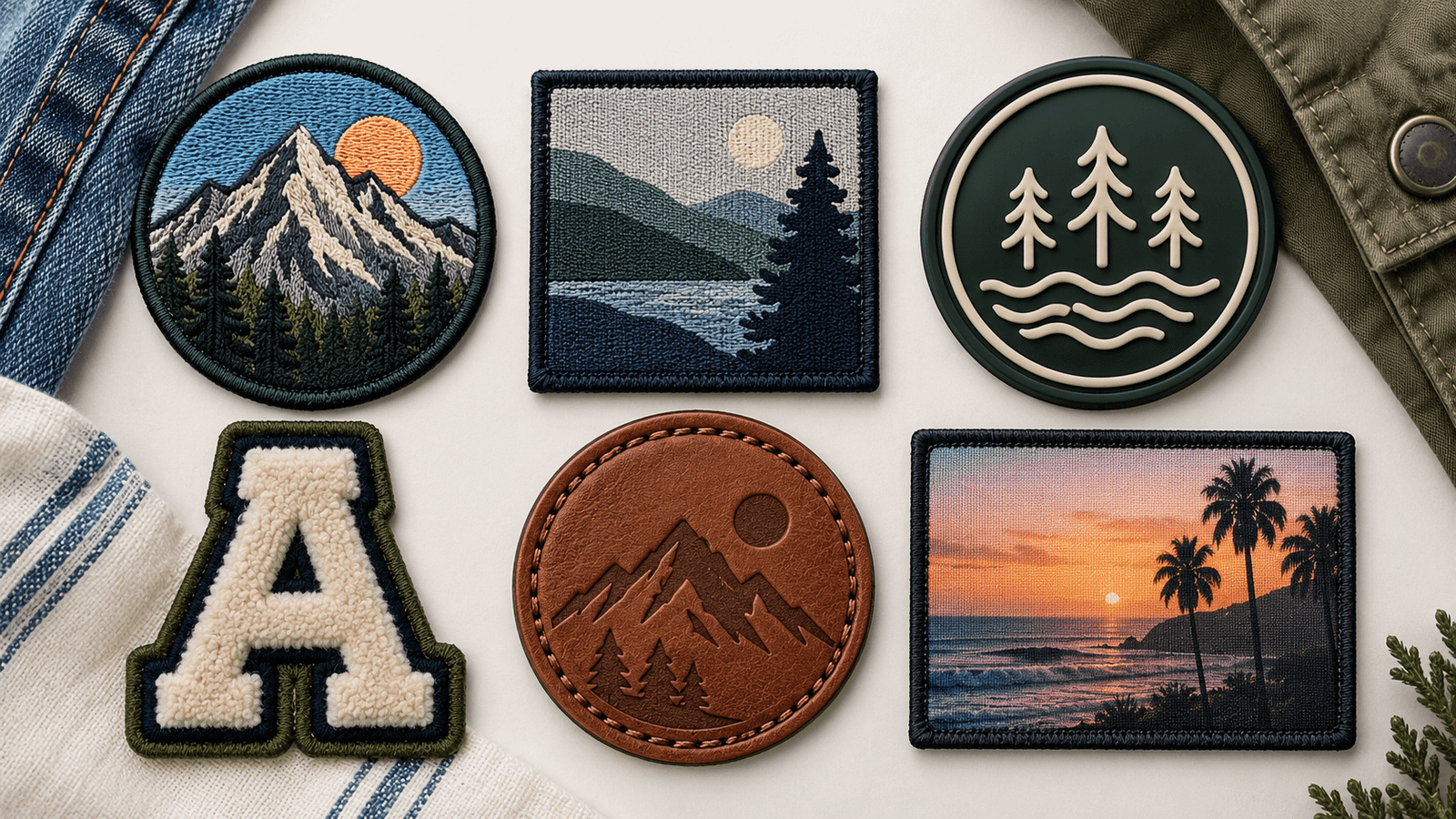
| Patch Type | Appearance | Works Well For |
|---|---|---|
| Embroidered | Raised, stitched, textured | Jackets, uniforms, workwear, polos |
| Woven | Smooth, detailed, lightweight | Logos, small lettering, fashion apparel |
| PVC | Molded, flexible, modern | Outdoor clothing, workwear, tactical apparel |
| Chenille | Soft, thick, raised | Varsity jackets, school and sports apparel |
| Leather | Premium, structured | Denim, jackets, workwear, fashion branding |
| Sublimated | Printed, highly detailed | Complex artwork, gradients, photographic designs |
The right option depends on your artwork, garment material, desired appearance, and how the clothing will be worn.
Types of Patches for Clothing
Different patch materials create different textures and levels of detail. Understanding these differences makes it easier to choose a patch that fits both the design and the garment.
Embroidered Patches
Custom Embroidery Patches are made using thread stitched onto a fabric base.
The raised stitching gives them the classic patch appearance commonly associated with uniforms, clubs, teams, jackets, and branded workwear.
Embroidery works particularly well for:
- Bold logos
- Company names
- Large lettering
- Simple symbols
- Uniform emblems
- Jacket patches
- Team designs
Because embroidery has a textured surface, extremely fine lines or very small lettering may be less suitable than they would be on a woven patch.
For a traditional stitched appearance, embroidered patches are one of the most versatile options for clothing.
If your main concern is whether embroidery can reproduce your artwork clearly, read our Woven vs. Embroidered Patches guide.
Woven Patches
Custom Woven Patches use finer threads woven closely together instead of creating the heavier raised texture associated with embroidery.
This produces a smoother and flatter surface.
Woven patches are especially useful when a design contains:
- Small lettering
- Fine lines
- Detailed logos
- Complex shapes
- Intricate illustrations
Their relatively lightweight construction also makes them suitable for shirts, uniforms, fashion garments, labels, jackets, and other clothing where a lower-profile patch is preferred.
If you are choosing between woven and embroidered designs, our Woven vs. Embroidered Patches comparison explains the differences in texture, artwork detail, lettering, and common uses.
PVC Patches
Custom PVC Patches have a flexible, rubber-like construction rather than a thread-based surface.
They provide a modern appearance and work especially well when durability, moisture resistance, or easy cleaning matters.
Common applications include:
- Outdoor clothing
- Workwear
- Tactical-style apparel
- Jackets
- Uniforms
- Sports gear
PVC patches can also support raised 2D or 3D elements and bold shapes.
Because PVC behaves differently from fabric patches, the attachment method should be selected according to the garment and intended use.
For a deeper look at the material, read Why Choose PVC Patches? Benefits, Uses & Customization Options.
If you are choosing between traditional embroidery and PVC, our PVC vs. Embroidered Patches guide compares appearance, durability, design detail, weather resistance, and common applications.
Chenille Patches
Custom Chenille Patches are recognizable for their soft, thick, raised texture.
They are closely associated with:
- Varsity jackets
- Letterman jackets
- School apparel
- Sports teams
- Clubs
- Large initials and numbers
Chenille works particularly well when the patch itself is intended to be a prominent part of the garment’s design.
Large letters, mascots, numbers, and simple graphic shapes tend to work better than very fine artwork.
This makes chenille a particularly strong option for varsity-style clothing, team apparel, and statement jacket designs.
Leather Patches
Custom Leather Patches provide a completely different visual character from embroidered or woven patches.
They are commonly used on:
- Denim jackets
- Workwear
- Jeans
- Fashion apparel
- Outerwear
- Branded merchandise
- Hats and accessories
A leather patch can give clothing a more structured or premium appearance, particularly when the design uses a logo, monogram, lettering, or relatively simple brand mark.
Leather patches are especially useful when a clothing brand wants the patch itself to contribute to the overall visual identity of the garment.
Sublimated Patches
Custom Sublimation Patches are useful when artwork contains more visual detail than traditional stitching can easily reproduce.
They can accommodate elements such as:
- Color gradients
- Complex artwork
- Detailed illustrations
- Multiple colors
- Photographic-style imagery
Sublimated patches have a flatter printed appearance compared with textured embroidered or chenille patches.
They can be a practical option for clothing designs that require detailed artwork, complex colors, or graphics that would be difficult to reproduce with thread.
Where Should You Place a Patch on Clothing?
There is no single correct location for a clothing patch.
Placement depends on the garment, patch dimensions, design purpose, and how visible you want the patch to be.
Before production or attachment, consider the proportions of both the patch and the garment.
Chest Placement
The left or right chest is one of the most common locations for patches on shirts, jackets, polos, workwear, and uniforms.
Chest patches are often used for:
- Company logos
- Employee names
- Department identification
- Club emblems
- Small brand marks
- Uniform badges
A compact patch usually works better here than an oversized design because it needs to fit comfortably within the chest area without interfering with seams, pockets, buttons, or zippers.
Businesses creating branded shirts, jackets, or uniforms can explore Custom Clothing Patches for suitable materials and backing options.
Sleeve Placement
Sleeves provide a visible location without occupying the main front or back of the garment.
Sleeve patches are often used for:
- Flags
- Organization emblems
- Secondary logos
- Team marks
- Department identifiers
- Decorative artwork
Before choosing sleeve placement, check for seams, cuffs, pockets, or other structural elements that might affect attachment.
Sleeve and shoulder placement is also commonly associated with organizational and military-style patches. Our Army Unit Patches Complete Guide explains common materials, applications, and design considerations in more detail.
Jacket Back Placement
The back of a jacket gives you considerably more design space.
Large patches are often placed on:
- Denim jackets
- Motorcycle-style jackets
- Club jackets
- Work jackets
- Varsity jackets
- Fashion outerwear
A large jacket back patch can contain more prominent lettering, logos, illustrations, or emblems than a small chest patch.
If the patch will cover a large area, flexibility and garment movement should also be considered.
The available materials under Custom Clothing Patches can help you choose a style suited to jacket applications.
Front Jacket Placement
Small patches can be positioned on either side of the front of a jacket.
This works well for:
- Logos
- Names
- Small symbols
- Numbers
- Club identification
- Supporting graphics
Some jacket designs combine a small front patch with a much larger design across the back.
Shoulder Placement
Shoulder or upper-sleeve patches are commonly associated with uniforms and organization identification.
This location can work for logos, department insignia, security identification, team emblems, or other compact designs.
The patch should be sized carefully so it follows the garment naturally rather than extending into areas where the fabric bends excessively.
Pocket Placement
Patches can sometimes be positioned directly above, beside, or on suitable pockets.
This placement works particularly well for names, logos, small brand marks, and workwear identification.
However, attaching a patch directly over a functional pocket may limit access to the pocket, so the garment construction should be considered first.
Hoodie Placement
Hoodies provide several possible patch locations:
- Left or right chest
- Sleeve
- Upper arm
- Lower front
- Back
- Near the hem
Streetwear and clothing brands can also use unconventional placement to make the patch part of the garment’s visual identity.
Choosing Patch Size for Clothing
Patch size should be considered together with placement.
A patch that looks appropriately sized on a jacket back may overwhelm the chest of a polo shirt. Likewise, a very small patch may become visually lost on oversized outerwear.
Before finalizing the size, consider:
Garment size: Adult outerwear provides more usable space than children’s clothing or fitted apparel.
Placement area: Chest and sleeve placements generally require smaller patches than jacket backs.
Artwork complexity: Designs with text and fine details may need additional space to remain readable.
Viewing distance: Uniform identification or branding may need to remain recognizable from several feet away.
Garment structure: Avoid placing important design elements where seams, folds, zippers, or pockets interfere with the patch.
Creating the patch around its actual garment placement usually produces better results than choosing the size independently.
Headwear requires a different approach because the usable panel is much smaller. If the same logo will also appear on caps, read our Custom Hat Patches Guide for hat-specific sizing, placement, materials, and backing considerations.
How Are Patches Attached to Clothing?
The attachment method is just as important as the patch material.
The most common options include sew-on, iron-on, heat-applied, and hook-and-loop attachment.
Each works differently.
Sew-On Patches
Sewing a patch directly to the garment creates a physical attachment around the edge of the patch.
Sew-on patches are commonly used on:
- Jackets
- Uniforms
- Workwear
- Denim
- Shirts
- Frequently worn garments
Sewing is especially useful when you want the patch to remain permanently attached.
It can also be a practical choice for garments that may not be suitable for high heat.
When Is Sew-On Best?
Consider a sew-on attachment when the garment will be worn frequently, washed regularly, or used in environments where a more permanent attachment is preferred.
The quality of the stitching and garment fabric will affect the finished result.
Iron-On Patches
Iron-on patches use a heat-activated adhesive backing.
Heat and pressure activate the adhesive so the patch bonds to a compatible fabric.
Iron-on attachment can be convenient for garments that tolerate the required application temperature.
However, not every fabric should be exposed to high heat.
Always check the garment’s care instructions before applying an iron-on patch. Heat-sensitive fabrics, coated materials, stretch fabrics, waterproof garments, or garments containing certain synthetic fibers may require a different attachment method.
Heat Press Application
A heat press uses controlled temperature, pressure, and application time to attach compatible patches.
This can provide more consistent heat and pressure than a household iron, which makes heat pressing useful when applying multiple patches to garments.
The correct settings depend on the patch backing and clothing material.
Always follow the application requirements for the particular patch and garment rather than assuming one temperature works for every material.
Hook-and-Loop Patches
Hook-and-loop backing is designed for patches that need to be removable or interchangeable.
It is commonly used on:
- Uniforms
- Workwear
- Tactical-style clothing
- Jackets
- Equipment
- Gear
Instead of permanently fixing the patch to the garment, the patch connects to a compatible loop panel.
This makes it easy to change names, identifiers, logos, morale designs, or other patches when required.
Hook-and-loop attachment is particularly common with tactical and unit-style designs. See our Army Unit Patches Guide for more examples.
Which Patch Attachment Method Is Best?
There is no attachment method that is best for every garment.
Use this general framework:
| Requirement | Attachment to Consider |
|---|---|
| Permanent attachment | Sew-on |
| Quick application to compatible fabric | Iron-on |
| Consistent heat application for multiple garments | Heat press |
| Removable or interchangeable patch | Hook-and-loop |
| Heat-sensitive garment | Sew-on or another compatible non-heat method |
| Frequently washed clothing | Secure permanent attachment may be preferable |
The garment’s care label and fabric construction should always be checked before applying heat, adhesives, or stitching.
When ordering Custom Clothing Patches, choose the backing based on both the garment material and whether you want the patch to be permanent or removable.
Choosing Patches for Different Clothing Materials
The garment material affects both appearance and attachment.
Denim
Denim provides a relatively structured surface and is commonly paired with embroidered, chenille, woven, and leather patches.
Jackets and jeans can accommodate both small accent patches and larger statement designs.
For a traditional look, consider Custom Embroidery Patches, while Custom Leather Patches can provide a more structured branded appearance.
Cotton
Cotton garments can work with many patch types, although fabric weight matters.
A heavier cotton jacket can support a more substantial patch than a lightweight T-shirt.
Polyester
Polyester is common in uniforms, sportswear, and performance clothing.
Because some polyester garments can be sensitive to excessive heat, check garment care instructions before using an iron-on or heat-applied patch.
Nylon and Performance Fabrics
Outdoor apparel and technical garments may contain nylon, coatings, stretch fibers, waterproof membranes, or other heat-sensitive materials.
These garments require extra attention when choosing an attachment method.
Do not assume that an iron-on backing is suitable simply because the patch itself supports heat application.
For outdoor or demanding applications, Custom PVC Patches may also be worth considering.
You can compare PVC with traditional stitching in our PVC vs. Embroidered Patches guide.
Stretch Fabrics
A rigid patch placed over an area that regularly stretches can affect how the garment moves.
For stretch apparel, choose the patch size and placement carefully and avoid positioning a large patch across areas that need significant flexibility.
Patches for Uniforms and Workwear
Clothing patches are frequently used as part of a uniform system.
They can identify:
- Businesses
- Employees
- Departments
- Job roles
- Organizations
- Teams
- Security personnel
- Clubs
For workwear, visibility and durability are usually more important than purely decorative considerations.
Placement should be consistent across garments, particularly when patches form part of a company’s visual identity.
Businesses creating coordinated uniforms can explore Custom Clothing Patches or browse the complete Custom Patches collection to compare different materials.
Patches for Clothing Brands and Streetwear
Patches can also function as a design element rather than simply an identifier.
Fashion and streetwear brands can use custom patches to introduce:
- Brand logos
- Limited-edition graphics
- Collection identifiers
- Typography
- Artwork
- Decorative textures
- Contrasting materials
Combining the garment material with the right patch texture can help make the patch feel like an intentional part of the clothing rather than an addition applied afterward.
For example, Custom Chenille Patches create a very different aesthetic from Custom Leather Patches, woven thread, embroidery, or PVC.
Brands can compare all these options through the Custom Patches collection.
Patches for Jackets
Jackets are among the most versatile garments for custom patches because they offer multiple placement areas and generally have more structure than lightweight clothing.
Popular options include:
- Small embroidered chest patches
- Large jacket back patches
- Sleeve patches
- Chenille varsity letters
- Leather brand patches
- Woven logo patches
- Decorative fashion patches
Before designing a jacket patch, decide where it will be positioned. The available area should influence the patch dimensions and artwork from the beginning.
For jacket-specific customization, explore Custom Clothing Patches.
How to Choose the Right Clothing Patch
Start with four questions:
What garment will the patch go on?
A work uniform, denim jacket, polo, varsity jacket, and outdoor garment all have different requirements.
What does your artwork look like?
Bold logos may work well with Custom Embroidery Patches, while small lettering and detailed graphics may benefit from Custom Woven Patches.
If artwork detail is your main concern, compare the two in our Woven vs. Embroidered Patches guide.
Where will the patch be placed?
Chest, sleeve, back, pocket, and shoulder placements require different dimensions.
Should the patch be permanent or removable?
This will help determine whether sew-on, iron-on, heat-applied, or hook-and-loop backing makes the most sense.
Making these decisions before production can prevent problems with sizing, readability, placement, and attachment later.
Once you know what you need, browse Custom Patches or go directly to Custom Clothing Patches.
How to Care for Clothing With Patches
Patch care depends on both the garment and patch material.
As a general rule, check the clothing care label and the requirements of your chosen patch before washing or drying.
Turning patched garments inside out, avoiding unnecessarily harsh washing conditions, and limiting excessive heat can help protect many patch styles.
For detailed washing, drying, and maintenance instructions, read Caring for Custom Patches: How to Wash, Maintain & Dry.
That guide covers embroidered, woven, PVC, chenille, sublimation, leather, and other patch materials as well as different backing and attachment considerations.
Create Custom Patches for Your Clothing
A successful clothing patch starts with more than choosing an attractive design.
The patch type, garment, dimensions, placement, artwork, and attachment method should all work together.
PatchesOrder creates Custom Clothing Patches for shirts, jackets, uniforms, workwear, sportswear, fashion apparel, brands, teams, clubs, businesses, and personal projects.
You can also browse all Custom Patches if you want to compare embroidered, woven, PVC, chenille, leather, and sublimated options before ordering.
Choose the patch style that fits your artwork, determine where it will be placed, and select an attachment method suited to your garment.
Ready to turn your artwork or logo into a clothing patch?
Request a Free Quote from PatchesOrder.
Frequently Asked Questions About Clothing Patches
What type of patch is best for clothing?
The best patch depends on the garment and design. Embroidered patches provide a traditional stitched texture, woven patches work well for fine detail, chenille patches suit varsity-style apparel, PVC offers a molded appearance, and leather can create a more structured branded look.
Where should patches be placed on clothing?
Common patch locations include the chest, sleeve, shoulder, pocket area, jacket front, and jacket back. The best placement depends on patch size, garment construction, visibility, and the purpose of the design.
What is the best way to attach a patch to clothing?
Sew-on attachment is useful for a permanent application, iron-on backing offers convenient heat application on compatible fabrics, and hook-and-loop backing works when patches need to be removed or changed.
Can you iron patches onto any clothing?
No. Not every garment is suitable for heat application. Check the garment’s care label and patch instructions first. Heat-sensitive synthetic fabrics, coated materials, stretch fabrics, and some technical garments may require an alternative attachment method.
Are sew-on patches better than iron-on patches?
Neither method is automatically better. Sew-on attachment is useful when a permanent physical connection is preferred or when the garment is unsuitable for heat. Iron-on patches provide convenient application when both the fabric and patch backing are designed for heat.
Can patches be added to denim jackets?
Yes. Denim jackets are commonly customized with embroidered, woven, chenille, leather, and other patch styles. Small patches can be positioned on the chest or sleeves, while larger designs can be placed across the back.
Explore Custom Clothing Patches for jacket and denim applications.
Can patches be put on hoodies?
Yes. Patches can be added to suitable hoodies on areas such as the chest, sleeves, upper arms, front, or back. The attachment method should be compatible with the hoodie material.
What type of patch works best for a detailed logo?
Custom Woven Patches are often a strong option when artwork contains small lettering, fine lines, or intricate details. Embroidery works particularly well when a raised, textured appearance is more important.
For a detailed comparison, read Woven vs. Embroidered Patches.
Can clothing patches be removed?
It depends on the attachment. Hook-and-loop patches are specifically designed to be removable. Sew-on patches can usually be removed by carefully taking out the stitches, while adhesive and heat-applied patches may leave residue or affect the underlying garment.
Can custom patches be used for clothing brands?
Yes. Clothing brands can use custom patches for logos, collection branding, streetwear, jackets, merchandise, labels, workwear, and other apparel.
Explore Custom Clothing Patches to choose the material, dimensions, artwork, and backing for your garments.
