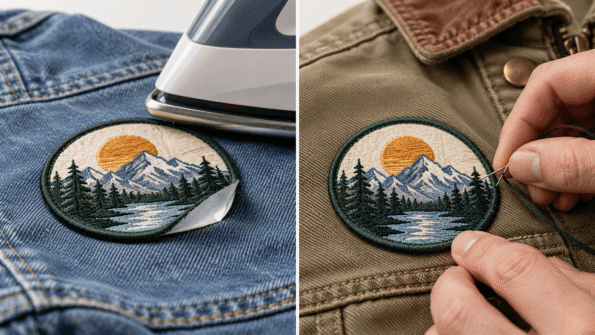
Choosing between iron-on and sew-on embroidered patches comes down to how the patch will be used.
Iron-on patches are usually the more convenient option for compatible, heat-safe fabrics when you want quick application without sewing. Sew-on patches are better suited to long-term attachment, frequent wear, repeated laundering, or garments that should not be exposed to high heat.
Neither method is automatically better.
The right choice depends on the garment, fabric, washing routine, expected wear, and whether you may need to repair or remove the patch later.
This guide compares iron-on vs sew-on embroidered patches specifically, so you can choose the attachment method that makes sense before ordering your Custom Embroidery Patches.
Iron-On vs Sew-On Patches at a Glance
| Factor | Iron-On Embroidered Patch | Sew-On Embroidered Patch |
|---|---|---|
| Attachment | Heat-activated backing | Thread stitching |
| Application speed | Usually faster | Takes more time |
| Sewing required | No | Yes |
| Heat required | Yes | No |
| Best for heat-sensitive fabric | Usually no | Yes |
| Long-term attachment | Good when correctly applied | Very secure |
| Frequent laundering | Requires appropriate care | Often better suited |
| Easy to repair | Limited once adhesive fails | Stitching can usually be repaired |
| Easy to remove | Can be difficult | Stitches can be removed |
| Good for curved areas | Depends on surface | Often easier to adapt |
| Equipment needed | Iron or heat press | Needle/thread or sewing machine |
| Best use | Convenient apparel application | Durable permanent attachment |
The table is a starting point. Always consider the actual fabric and care instructions before choosing a backing.
What Is an Iron-On Embroidered Patch?
An iron-on embroidered patch has a heat-activated adhesive layer on the back.
Heat and pressure activate that layer and bond the patch to a compatible garment or fabric surface.
The embroidered design remains on the front, while the backing handles attachment.
Iron-on patches are commonly considered for garments such as:
- Denim
- Cotton clothing
- Jackets
- Work shirts
- Casual apparel
- Tote bags
- Certain uniforms
The key word is compatible.
A garment may look suitable but still contain fibers, coatings, finishes, or construction details that should not be exposed to the heat needed for application.
What Is a Sew-On Embroidered Patch?
A sew-on embroidered patch is physically attached using thread.
Stitches are normally placed around the patch edge so the patch and garment become mechanically connected.
Sew-on attachment works well when you want the patch to stay in place through:
- Regular wear
- Repeated movement
- Washing
- Work use
- Outdoor use
It also avoids the need to expose the garment to application heat.
Sew-on embroidered patches are commonly used on:
- Uniforms
- Jackets
- Workwear
- Denim
- Bags
- Club apparel
- Team clothing
- Some hats
If you want a broader explanation of other options such as hook-and-loop and adhesive, see our Patch Backing Types Guide.
The Biggest Difference: Heat vs Stitching
The main distinction is simple.
Iron-on uses heat and adhesive.
Sew-on uses thread and stitches.
That difference affects almost everything else: application, fabric compatibility, washing, future repairs, and removal.
Iron-on attachment depends on the adhesive maintaining its bond with the fabric.
Sew-on attachment depends on the physical stitching remaining intact.
Understanding that relationship makes the comparison much easier.
Iron-On vs Sew-On: Which Is Easier to Apply?
Iron-on is usually the more convenient option.
With a compatible garment and properly prepared patch, you position the patch, apply the required combination of heat and pressure, and allow the bond to set according to the application instructions.
There is no need to sew around the entire edge.
That can be useful when applying patches to multiple:
- Shirts
- Jackets
- Uniforms
- Promotional garments
Sew-on attachment requires more manual work.
Depending on the project, you may need:
- Needle
- Thread
- Sewing machine
- Commercial sewing equipment
- Professional alteration service
For a one-off patch, hand sewing may be practical.
For a large apparel order, machine sewing is generally more efficient.
Convenience Winner: Iron-On
If your primary concern is easy installation and the garment safely supports heat application, iron-on has the advantage.
Which Is More Permanent: Iron-On or Sew-On?
For long-term physical attachment, sew-on generally provides the more mechanically secure solution because stitches hold the patch directly to the garment.
Iron-on patches rely on the adhesive bond between:
Patch → adhesive → garment
That bond can perform well when properly applied to a compatible fabric, but it can be affected over time by factors such as:
- Repeated washing
- Heat
- Flexing
- Moisture
- Surface texture
- Edge lifting
A sewn patch remains attached as long as the stitches and surrounding fabric remain intact.
This is why sewing is commonly considered when a patch is intended to stay on:
- Work uniforms
- Frequently worn jackets
- Club apparel
- Service clothing
- Bags
- Long-term branded garments
Permanence Winner: Sew-On
For a patch intended to stay attached through extended use, sewing is generally the stronger choice.
Which Is Better for Frequent Washing?
How often the garment will be washed should influence the decision before you order.
Iron-on adhesive is repeatedly exposed to:
- Water
- Detergent
- Agitation
- Drying
- Heat
- Fabric movement
Over time, those conditions can affect the adhesive bond, particularly around the patch edges.
A properly sewn patch does not depend on adhesive remaining bonded to the fabric.
For workwear, uniforms, team apparel, or other garments that may be washed regularly, sew-on attachment is generally the more practical long-term choice.
That does not mean an iron-on patch cannot be washed.
It means laundering puts different stress on adhesive than it does on physical stitching.
For broader washing and maintenance advice, see How to Wash and Care for Custom Patches.
Can You Reinforce an Iron-On Patch With Sewing?
Often, yes.
Some buyers use the iron-on backing to position and initially attach a compatible patch, then sew around the edge for additional security.
This creates a combination of:
- Adhesive contact
- Physical stitching
It can be useful for garments that will experience frequent movement or laundering.
However, confirm that the specific patch and garment are suitable for both heat application and sewing before combining the methods.
Fabric Compatibility: Iron-On vs Sew-On
Fabric compatibility is one of the most important differences between the two methods.
An iron-on patch cannot be treated as suitable for every garment simply because the patch itself has heat-activated backing.
The garment must also tolerate the required temperature and pressure.
Sew-on attachment avoids that issue.
Garment Compatibility Table
| Garment / Material | Iron-On | Sew-On | Main Consideration |
|---|---|---|---|
| Denim jacket | Often suitable | Suitable | Check garment care instructions |
| Heavy cotton | Often suitable | Suitable | Test heat compatibility |
| Cotton work shirt | Often suitable | Suitable | Consider washing frequency |
| Polyester garment | Use caution | Often suitable | Polyester can react to excessive heat |
| Nylon | Often risky | Usually preferred | Heat sensitivity can be an issue |
| Waterproof jacket | Use caution / often avoid | Depends on construction | Heat or stitching may affect coatings |
| Stretch fabric | Often less suitable | Use carefully | Patch may restrict stretch |
| Leather garment | Generally avoid home ironing | Professional sewing may be possible | Material can be damaged |
| Denim jeans | Often suitable | Suitable | Avoid seams and high-flex areas |
| Work jacket | Depends on fabric | Often suitable | Frequent wear favors secure attachment |
| Uniform | Depends on fabric | Often suitable | Consider laundering and policy |
| Hat / cap | Application can be difficult | Often suitable | Curvature complicates heat pressure |
| Backpack | Depends on material | Often suitable | Check coatings and internal layers |
These are general guidelines, not manufacturer-specific application instructions.
Always check the garment care label and the specific patch application instructions.
Safety: Do Not Assume Every Fabric Can Be Ironed
This is particularly important.
Do not apply high heat to a garment until you have confirmed that its fabric, coating, decoration, and construction can tolerate it.
Some materials can:
- Melt
- Scorch
- Discolor
- Become shiny
- Warp
- Lose waterproof coatings
- Develop adhesive marks
Potentially heat-sensitive materials can include certain:
- Polyester fabrics
- Nylon
- Performance fabrics
- Waterproof materials
- Coated fabrics
- Stretch fabrics
- Delicate synthetics
Also consider what may be underneath the application area.
A jacket, bag, or uniform may contain:
- Waterproof membrane
- Insulation
- Foam
- Adhesive layers
- Decorative coating
that reacts differently from the visible outer fabric.
When unsure, choose another attachment method or seek garment-specific guidance rather than experimenting with excessive heat.
Iron-On Patches on Cotton
Cotton is often one of the more straightforward fabrics for heat application, provided the garment care instructions permit it.
Smooth cotton gives the backing a relatively even surface to contact.
Potential applications include:
- Work shirts
- Casual shirts
- Tote bags
- Cotton jackets
But fabric blends matter.
A garment described casually as a “cotton shirt” may contain polyester, elastane, coatings, or other fibers.
Check the actual label first.
Iron-On Patches on Denim
Denim is a common application for embroidered patches.
Its relatively sturdy construction can make it suitable for:
- Jacket chest patches
- Jacket back patches
- Jeans
- Denim bags
Both iron-on and sew-on approaches can work depending on the actual garment.
Choose according to whether convenience or long-term mechanical attachment matters more.
For a jacket that will be worn and washed frequently, sewing around the edge can provide added security.
Iron-On Patches on Polyester
Use more caution with polyester.
Different polyester garments respond differently to heat, and excessive temperature can damage some synthetic fabrics.
Do not assume that settings used successfully on cotton will also be safe on polyester.
If the garment care instructions do not support the required application heat, choose sewing or another suitable attachment method.
Iron-On Patches on Nylon
Nylon can be sensitive to heat, making home iron application a poor choice for many nylon garments and bags.
It can also contain coatings that add another variable.
For suitable nylon items, sewing may avoid heat-related damage, although the structure and waterproofing of the item still need to be considered.
What About Waterproof or Technical Clothing?
Technical outerwear requires extra care.
The visible fabric may only be one part of a layered construction.
The garment can also contain:
- Waterproof membranes
- Durable water-repellent finishes
- Seam tape
- Insulation
- Laminated layers
Heat can potentially affect those materials.
Sewing can also puncture waterproof layers.
So neither method should automatically be applied to technical outerwear without considering the garment construction.
For expensive waterproof clothing, consult the garment manufacturer’s instructions before modifying it.
Which Method Looks Cleaner?
Both methods can look professional when applied correctly.
With iron-on attachment, there are usually no visible installation stitches around the outside of the patch.
That can provide a clean edge appearance.
With sew-on attachment, a neat stitch line may be visible depending on:
- Thread color
- Stitch placement
- Border type
- Sewing technique
Matching the sewing thread to the patch border can make the attachment less noticeable.
For workwear or traditional patch applications, visible sewing may also look completely natural.
So this is primarily an aesthetic preference rather than a quality difference.
Which Method Is Better for Repairs?
Sew-on attachment has an important advantage: repairability.
If a section of stitching becomes loose, that area can often be resewn without replacing the entire patch.
If an iron-on patch begins lifting because the adhesive bond is weakening, the options depend on:
- Patch condition
- Garment condition
- Original backing
- Remaining adhesive
- Fabric compatibility
In some cases, stitching around the edge may rescue an iron-on patch that has begun lifting.
But repeatedly heating an unsuitable garment is not a good repair strategy.
Repairability Winner: Sew-On
Physical stitches are easier to inspect and repair individually.
Which Is Easier to Remove?
Sew-on patches are generally easier to remove in a controlled way.
The stitches can be carefully cut and removed.
That does not mean removal is completely invisible—the garment may retain:
- Small needle holes
- Stitch marks
- Fabric impressions
- Fading differences
But the patch is not chemically bonded to the surface.
Removing an iron-on patch can be more complicated because adhesive may remain on the garment.
Heat used during removal can also affect the underlying fabric.
If you think the patch may need to be replaced later, consider that before choosing iron-on backing.
Which Is Better for Uniforms?
For uniforms that receive frequent wear and laundering, sew-on attachment is often the more practical long-term option.
It works particularly well when:
- Patch position needs to remain consistent
- The uniform is washed regularly
- The garment should not be exposed to additional heat
- Repairs may be needed later
Iron-on can still be convenient on compatible uniform fabrics, especially when fast application is important.
The uniform material and usage pattern should determine the choice.
For broader apparel applications, explore Custom Clothing Patches.
Which Is Better for Workwear?
Workwear often experiences more:
- Movement
- Washing
- Abrasion
- Outdoor exposure
- Daily wear
than casual clothing.
For that reason, sewing is commonly the more durable attachment approach.
A company applying embroidered logos to jackets that employees wear every day may prioritize permanence over application speed.
For lighter promotional clothing used occasionally, iron-on may offer enough convenience.
Which Is Better for Jackets?
Both can work.
Choose Iron-On When:
- The jacket material is confirmed heat-safe.
- You want quick application.
- The surface is reasonably flat.
- The garment is not highly technical or coated.
Choose Sew-On When:
- The jacket receives frequent use.
- Long-term attachment is important.
- Heat could damage the fabric.
- The patch is large.
- You want easier future repairs.
Large jacket-back embroidered patches are often good candidates for sewing because their edges can experience significant movement.
Which Is Better for Hats?
Sewing is often easier to control on caps because hats have:
- Curved crowns
- Seams
- Structured panels
- Internal layers
Getting completely even heat and pressure across a curved surface can be more difficult than on a flat shirt or jacket panel.
Specialized heat equipment may change that, but for a typical consumer application, sewing is often a practical permanent solution.
Which Is Better for Children’s Clothing?
The same rules apply:
- Check the fabric.
- Consider washing frequency.
- Avoid unsafe heat.
- Make sure attachment is secure.
Children’s clothing may be washed frequently, which makes long-term attachment especially relevant.
The patch should also be placed where it does not create uncomfortable stiffness against high-movement areas.
Does Patch Size Affect the Choice?
Yes, indirectly.
A small chest patch presents a different attachment challenge from a large embroidered jacket-back design.
Larger patches have:
- More surface area
- Longer edges
- Greater interaction with garment movement
If a large patch will be subjected to frequent flexing, edge security becomes increasingly important.
This can make sewing attractive for large permanent applications.
Does Embroidery Coverage Affect Iron-On vs Sew-On?
Not directly.
Embroidery coverage describes how much of the visible patch face is covered in thread.
Backing determines how the patch attaches.
They are separate specifications.
A patch can have partial, high, or full embroidery coverage and still use an appropriate backing selected for the garment.
If you are still determining the construction of the patch itself, read our Custom Embroidered Patch Guide.
How to Apply an Iron-On Embroidered Patch
Exact temperature, pressure, and time can vary by backing and garment, so follow the application instructions supplied for your specific patch.
The general process is:
1. Check the Garment
Read the care label and confirm that heat application is appropriate.
2. Choose the Position
Lay the garment flat and place the patch where it should sit.
Check alignment before applying any heat.
3. Protect the Garment and Patch
Follow the supplied instructions regarding protective material and whether heat should be applied from the front, reverse, or both.
4. Apply Heat and Pressure
Use the specified temperature, pressure, and duration.
Do not guess or simply choose the maximum iron setting.
5. Allow the Area to Cool
Avoid immediately pulling or flexing the patch before the bond has had the opportunity to set.
6. Check the Edges
Once cooled, inspect the patch carefully.
If the edges are not properly bonded, refer to the application instructions rather than repeatedly overheating the garment.
Important Application Note
PatchesOrder-specific temperature, pressure, and application times should be confirmed with the production team before exact numbers are published.
Using generic temperature recommendations for every fabric can damage garments.
How to Sew On an Embroidered Patch
Sewing is straightforward in principle, although technique affects the finish.
1. Position the Patch
Place the patch exactly where you want it.
Pins, temporary fabric-safe positioning methods, or careful hand placement can help keep it aligned.
2. Choose Suitable Thread
Thread can:
- Match the patch border
- Match the garment
- Provide intentional contrast
Matching the border generally makes the attachment less visible.
3. Stitch Around the Edge
Follow the patch perimeter with consistent spacing.
Keep the patch flat while sewing.
4. Secure the Thread
Make sure the beginning and end of the stitch line are properly secured.
5. Inspect the Garment
Check that the patch lies flat and that stitching has not unintentionally restricted:
- Pockets
- Zippers
- Stretch panels
- Linings
For thick jackets, structured hats, lined garments, or valuable apparel, professional sewing may produce a cleaner result.
Can You Sew an Iron-On Patch?
In many cases, yes.
Having heat-activated backing does not necessarily prevent stitching around the patch edge.
This can provide an additional mechanical attachment after heat application.
It may be worth considering for:
- Workwear
- Frequently washed garments
- Jackets
- Uniforms
However, confirm compatibility with the specific patch and garment before using both methods.
Iron-On vs Sew-On for Washing and Drying
Backing is only one part of garment care.
The embroidered patch itself also contains:
- Thread
- Fabric
- Border
- Backing material
For patched clothing, follow the care requirements of both the garment and patch.
As general practice:
- Avoid unnecessarily harsh washing.
- Do not exceed garment care temperatures.
- Inspect patch edges periodically.
- Avoid excessive dryer heat where possible.
- Repair loose sewing before it worsens.
For detailed care advice, use our Custom Patch Washing and Care Guide.
Iron-On vs Sew-On: Best Use Cases
Iron-On Makes More Sense When:
You want:
- Quick application
- No visible installation stitching
- A relatively simple DIY process
- Attachment to confirmed heat-safe fabric
- An easy solution for casual or promotional apparel
Sew-On Makes More Sense When:
You want:
- Long-term attachment
- Better repairability
- No heat exposure
- Frequent laundering
- Use on workwear or heavily worn apparel
- Better control on curved or structured items
Consider Both When:
You want easy initial positioning plus additional edge security and the garment safely supports both application methods.
How to Decide in 30 Seconds
Ask four questions.
1. Can the Garment Safely Handle Heat?
No or unsure → Sew-on
Yes → Continue
2. Will the Garment Be Washed Frequently?
Yes → Sew-on deserves stronger consideration
No → Either may work
3. Do You Need Fast DIY Application?
Yes → Iron-on
No → Either
4. Do You Want the Patch to Be Repairable or Removable Later?
Yes → Sew-on
No → Iron-on can be convenient
That simple decision process will solve most everyday iron-on vs sew-on comparisons.
Iron-On or Sew-On: Which Should You Choose?
There is no universal winner.
Choose iron-on embroidered patches when convenience is the priority and the garment is confirmed to tolerate the required heat and pressure.
Choose sew-on embroidered patches when permanence, frequent laundering, repairability, or avoiding heat matters more.
For heavily used uniforms, jackets, workwear, and other long-term applications, sewing is usually the safer practical choice.
For compatible casual garments where quick application matters, iron-on can be an efficient solution.
Most importantly, choose the backing based on the actual garment, not just the patch.
If you are still comparing embroidery specifications such as artwork, thread coverage, borders, and backing, read the Custom Embroidered Patch Guide.
For a comparison that includes hook-and-loop and adhesive options as well, see the Patch Backing Types Guide.
Ready to create your embroidered patches?
Request a Free Quote for Custom Embroidery Patches.
Frequently Asked Questions
Are iron-on patches as durable as sew-on patches?
Iron-on patches can provide a secure bond when correctly applied to compatible fabric, but sew-on patches rely on physical stitching rather than adhesive. For frequent washing, heavy wear, or long-term uniform use, sewing is generally the more dependable attachment method.
Can I sew an iron-on embroidered patch after ironing it?
Often, yes. Stitching around the edge can add mechanical security after heat application. Confirm that both the patch and garment are suitable for the combination before applying heat or sewing.
Can iron-on embroidered patches be washed?
They can be washed when the patch, adhesive, and garment support laundering, but repeated washing and high heat can place stress on the adhesive bond. Follow the garment and patch care instructions.
Is sew-on better for polyester?
Sew-on can avoid the heat risk associated with some polyester fabrics. Because polyester blends vary, check the garment’s care instructions before attempting iron-on application.
Can a sew-on patch be removed?
Yes. The stitches can usually be carefully cut and removed. The garment may retain small needle holes, stitch marks, or color differences where the patch previously covered the fabric.
Should I use iron-on or sew-on for a work uniform?
For a work uniform that experiences frequent wear and washing, sew-on attachment is generally a strong choice. Iron-on may still work on compatible fabrics when easy application is the priority.
What is the best option if I am unsure whether my fabric can handle heat?
Avoid applying heat until compatibility is confirmed. Sewing is generally the more appropriate alternative when heat tolerance is uncertain, although the garment construction should still be checked before modification.
