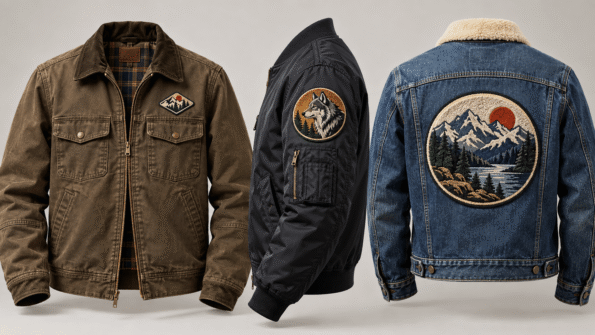
The best patch for a jacket depends on the jacket material, construction, placement, artwork, and how permanently you want the patch attached.
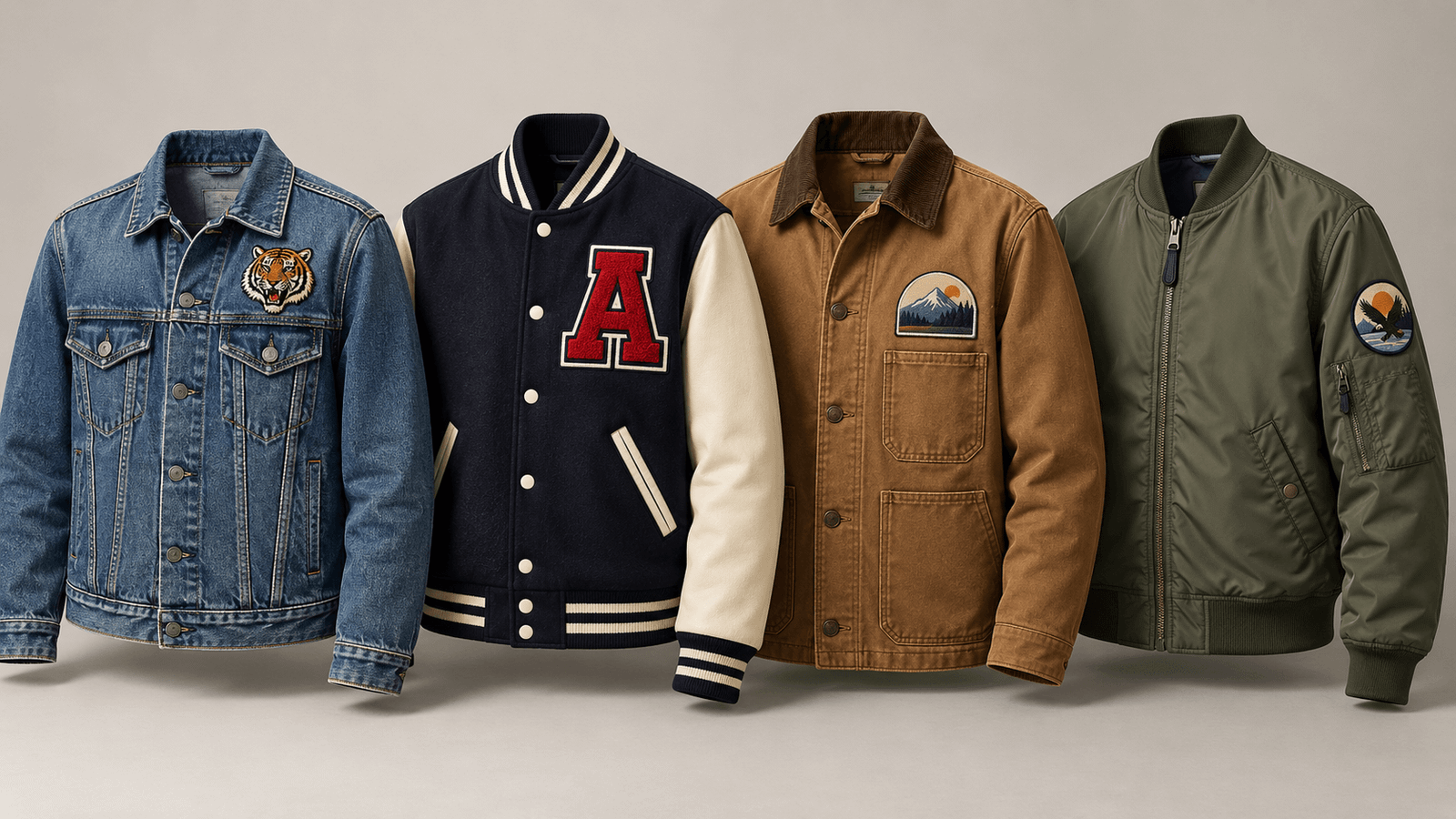
For denim and work jackets, embroidered, woven, or leather patches can work well depending on the design. Varsity jackets are especially suited to chenille and embroidered patches. Bomber and lined jackets need more attention to flexibility, lining access, seams, and attachment method.
Before choosing a patch, look at the jacket itself—not just the logo.
If you need a broader introduction to patch materials and clothing applications, read our Clothing Patch Guide first.
Quick Guide: Best Patch Options by Jacket Type
| Jacket Type | Patch Styles to Consider | Main Consideration |
|---|---|---|
| Denim | Embroidered, woven, leather | Structure supports many patch styles |
| Varsity / Letterman | Chenille, embroidered | Bold letters, numbers and mascots |
| Work Jacket | Embroidered, woven, PVC | Durability, visibility and washing |
| Bomber Jacket | Embroidered, woven | Fabric, lining and flexibility |
| Lined Jacket | Embroidered, woven, leather | Access to outer shell for attachment |
| Outdoor Jacket | PVC, embroidered, woven | Coatings, moisture and heat sensitivity |
This is a starting point rather than a fixed rule. The artwork and jacket construction should determine the final choice.
Start With the Jacket, Not the Patch
A patch that works perfectly on a heavy denim jacket may not behave the same way on a lightweight bomber jacket.
Before choosing a material, inspect:
- Outer fabric
- Fabric thickness
- Lining
- Pockets
- Zippers
- Seams
- Insulation
- Stretch
- Coatings
- Available placement area
These details affect patch weight, flexibility, positioning, and attachment.
The most successful custom jacket patches feel like part of the garment rather than something forced onto it.
Choosing Patches for Denim Jackets
Denim is one of the most flexible jacket materials for patches because it provides a relatively firm surface.
Common choices include Custom Embroidery Patches, woven patches, and Custom Leather Patches.
Embroidered Patches on Denim
Embroidery works well when you want:
- Traditional stitched texture
- Bold logos
- Club emblems
- Lettering
- Decorative graphics
Denim can support both small chest patches and larger back designs.
Leather Patches on Denim
Leather creates a different visual effect.
It can work particularly well for:
- Brand marks
- Simple logos
- Wordmarks
- Outdoor-inspired designs
- Fashion labels
The contrast between leather and denim can make even a simple design visually distinctive.
Jacket Back Patches on Denim
The back panel provides more room for large artwork than the chest or sleeve.
Before ordering, check where the:
- Shoulder yoke
- Side seams
- Waistband
- Decorative stitching
intersect the usable area.
Avoid choosing a patch simply because it technically fits between two seams. Leave enough open space for the design to look balanced.
Choosing Patches for Varsity and Letterman Jackets
Varsity jackets have a strong connection with large textured patches.
Custom Chenille Patches are especially suited to this style because their raised yarn texture works well for:
- Initials
- Numbers
- Mascots
- Team names
- School symbols
- Large letters
Chenille is visually bold, so it generally works best when the artwork is relatively simple and readable.
Fine text or intricate detail may be better handled by embroidery or woven construction.
Mixing Patch Styles on a Varsity Jacket
A jacket does not necessarily need every patch to use the same material.
For example, a varsity design could combine:
- Large chenille letter
- Smaller embroidered name
- Woven detail patch
The important factor is visual consistency.
Keep the colors, proportions, and placements coordinated so the jacket does not appear crowded.
Choosing Patches for Work Jackets
Work jackets often require a different decision process.
Appearance matters, but so do:
- Visibility
- Frequent wear
- Washing
- Abrasion
- Movement
- Long-term attachment
A company logo on a work jacket may need to remain readable after repeated use.
Embroidered patches are a common option because bold logos and lettering suit their raised stitched construction.
Woven patches can be useful when the company logo contains smaller text or finer lines.
PVC may also suit some work or outdoor applications when a molded appearance is preferred.
Keep Work Jacket Branding Easy to Read
A complicated logo does not always need every detail reproduced.
For workwear, simplify elements that become too small at the intended patch size.
The company name or primary symbol should remain recognizable without requiring someone to stand very close to the garment.
Choosing Patches for Bomber Jackets
Bomber jackets require more care because their outer fabrics can vary significantly.
Some use relatively lightweight synthetic shells, while others have heavier construction.
Before choosing the patch, check:
- Fabric composition
- Surface smoothness
- Lining
- Insulation
- Ribbed areas
- Pocket placement
- Heat tolerance
A very stiff or heavy patch can feel out of place on a lightweight jacket.
Embroidered and woven patches can both work, but the patch dimensions and flexibility should suit the garment.
Avoid High-Movement Areas
Bomber jackets naturally fold around:
- Shoulders
- Elbows
- Side panels
- Waist
Avoid placing large rigid patches directly across areas that need substantial movement.
Chest, upper sleeve, and back placements usually provide more stable surfaces, depending on the jacket design.
Choosing Patches for Lined Jackets
A lined jacket introduces another layer between the outer shell and the wearer.
That matters when the patch needs to be sewn.
If stitching passes through both the outer fabric and lining, the lining may become attached to the shell around the patch.
Sometimes that is acceptable. Sometimes it can affect how the garment hangs.
For a cleaner installation, a professional tailor or embroidery specialist may be able to access the outer shell separately, depending on how the jacket is constructed.
Check Lining Access Before Ordering
Look inside the jacket before selecting the final placement.
Ask:
- Can the outer shell be accessed?
- Is there insulation underneath?
- Will stitching interfere with an inside pocket?
- Will the patch position cross a lining seam?
- Is the garment reversible?
These questions become especially important for expensive or structured jackets.
Which Patch Type Is Best for a Jacket?
There is no universal winner.
Match the patch construction to the artwork and jacket.
Embroidered Patches
Consider embroidery for:
- Traditional logos
- Club patches
- Company branding
- Bold lettering
- Uniform-style emblems
Embroidery provides a raised thread texture that looks natural on many jackets.
Woven Patches
Consider woven construction when the design relies on:
- Fine lines
- Smaller lettering
- Intricate logos
- Lower-profile thread texture
Woven patches are useful when embroidery would require simplifying important details.
Chenille Patches
Choose chenille when visual texture is a major part of the design.
It works particularly well for varsity jackets, large letters, numbers, and mascots.
Leather Patches
Leather works well for denim, fashion, workwear, and outdoor-inspired jackets where a structured brand mark is preferred.
PVC Patches
Custom PVC Patches create a molded rather than stitched appearance.
They can suit bold logos, outdoor-style jackets, work applications, and removable patches when the garment includes a compatible attachment area.
Patch Rigidity Matters on Jackets
Patch thickness and stiffness should match the garment.
A heavier patch may work naturally on:
- Denim
- Thick workwear
- Structured varsity jackets
The same patch may feel oversized or restrictive on:
- Lightweight bombers
- Thin fashion jackets
- Flexible shells
This is especially important for large patches.
A patch that covers a substantial part of the back can affect how the fabric bends and folds.
If flexibility matters, do not choose a thick construction solely because it looks impressive when viewed separately from the garment.
Best Patch Placement on Jackets
The most common locations are:
Left or Right Chest
Useful for:
- Company logos
- Names
- Club emblems
- Small brand marks
Check pockets, zippers, and seams before choosing dimensions.
Upper Sleeve
Works well for:
- Secondary logos
- Flags
- Unit-style designs
- Team marks
Avoid making the patch so wide that it wraps excessively around the arm.
Jacket Back
Best for designs intended to make a strong visual statement.
Large back patches can accommodate:
- Club artwork
- Team branding
- Mascots
- Large logos
- Fashion graphics
Above or Beside a Pocket
Suitable for smaller branding, but the patch should not prevent the pocket from opening or closing normally.
Watch the Seams
Seams can cause problems during both placement and attachment.
A patch positioned partly on a flat panel and partly across a thick seam may:
- Sit unevenly
- Be harder to sew
- Fail to lie flat
- Create unnecessary bulk
Whenever possible, position the patch within a relatively uninterrupted fabric panel.
This is particularly important around:
- Shoulder seams
- Pocket seams
- Zippers
- Side panels
- Jacket yokes
Do not center a patch according to the entire jacket if doing so places it directly over difficult construction.
Center it according to the usable panel.
How Large Should a Jacket Patch Be?
Size depends on placement.
Chest and sleeve patches generally need less space than back patches.
The safest approach is to measure the actual jacket instead of relying on a universal size.
For a large back patch, measure the clear area between the shoulder structure and waistband.
Then create a paper template using the proposed dimensions and place it on the garment.
This quickly shows whether the patch looks:
- Too small
- Balanced
- Too dominant
It is much easier to change a paper template than a finished custom patch.
Sew-On or Iron-On for Jackets?
The right attachment depends heavily on the jacket material.
Sew-On
Sewing is useful when:
- Long-term attachment matters
- The jacket receives regular wear
- Heat should be avoided
- The patch is relatively large
- You want the attachment to be repairable
Iron-On
Iron-on backing can be convenient when:
- The outer fabric supports heat application
- The surface is reasonably flat
- Quick application matters
However, never assume a jacket is safe for ironing.
Synthetic fabrics, coated materials, insulated construction, and technical outerwear may react poorly to excessive heat.
Check the garment care label and specific patch application requirements first.
What About Hook-and-Loop Patches?
Hook-and-loop is useful when the jacket already has a compatible loop panel and the patch needs to be removable.
This is common on some:
- Tactical jackets
- Work garments
- Outdoor equipment
- Uniform-style clothing
The patch should fit within the loop area rather than extending past its edges.
If the jacket has no loop panel, adding one becomes a separate garment modification.
Special Considerations for Large Back Patches
Large jacket-back patches require more planning than small chest logos.
Review:
Artwork proportion: A wide logo may fit differently from a tall shield or circular emblem.
Garment movement: The patch should not make the back unnecessarily rigid.
Seams: Keep important artwork away from structural seams when possible.
Lining: Sewing a large patch may require access behind a substantial area of the outer shell.
Edge security: A large perimeter creates more area that needs to remain attached during wear.
Design the patch for that particular jacket rather than enlarging a smaller chest design without reconsidering its proportions.
A Simple Jacket Patch Selection Process
Use this sequence before ordering:
- Identify the jacket type. Denim, varsity, bomber, workwear, lined or outdoor.
- Choose the placement. Chest, sleeve, pocket area or back.
- Measure the usable panel. Ignore zippers, pockets and major seams.
- Match the patch to the artwork. Embroidered for classic texture, woven for fine detail, chenille for varsity impact, leather for structured branding, or PVC for a molded look.
- Check flexibility. Make sure the patch construction suits the weight and movement of the jacket.
- Choose attachment. Consider sewing, heat application or removable backing based on the garment.
- Review the final design on the jacket scale. A paper template can help before production.
Choose the Patch Around the Jacket
The most important rule is simple:
Do not choose a patch in isolation from the garment.
A custom jacket patch should work with the jacket’s material, structure, seams, lining, movement, and visual proportions.
Denim gives you flexibility across embroidered, woven, and leather designs.
Varsity jackets naturally support chenille and bold embroidery.
Work jackets benefit from clear, durable branding.
Bomber and lined jackets require more attention to weight, flexibility, heat, and construction.
Once you know the jacket, placement, artwork, and attachment requirements, choosing the patch becomes much easier.
Explore Custom Clothing Patches and request a free quote for your jacket patch design.
Frequently Asked Questions
What type of patch is best for a denim jacket?
Embroidered, woven, and leather patches can all work well on denim. Choose embroidery for raised thread texture, woven for finer detail, or leather for a structured branded appearance.
What patch is best for a varsity jacket?
Chenille is a strong option for large letters, numbers, mascots, and classic varsity-style designs. Embroidery can complement chenille when smaller logos or detailed elements are required.
Can you put a large patch on the back of a jacket?
Yes, provided the patch dimensions suit the clear back panel. Check shoulder seams, the waistband, lining, garment movement, and overall flexibility before approving the size.
Should jacket patches be sewn or ironed on?
Sewing is generally useful for secure long-term attachment. Iron-on can be convenient when the jacket material safely supports the required heat and pressure. Always check the garment care instructions first.
Can patches be added to lined jackets?
Yes, but the lining can complicate sewing. Check whether the outer shell can be accessed without unnecessarily attaching or damaging the lining, pockets, insulation, or internal construction.
Can I put patches over jacket seams?
It is usually better to avoid major seams when possible. A thick seam can make the patch sit unevenly and may complicate attachment.
What should I consider before ordering custom jacket patches?
Confirm the jacket material, patch placement, available dimensions, artwork complexity, desired patch style, garment flexibility, lining construction, and attachment method before production.
