Choosing the patch material is only half of the decision when ordering custom patches.
You also need to decide how the patch will attach to your clothing, uniform, hat, backpack, jacket, tactical gear, or other item.
That is where patch backing comes in.
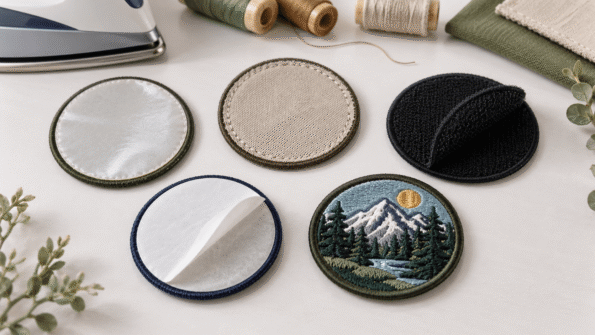
The backing sits on the reverse side of the patch and determines whether it can be ironed onto fabric, sewn permanently into place, removed and replaced, or temporarily attached using adhesive.
The four common options are:
- Iron-on backing
- Sew-on backing
- Hook-and-loop backing
- Adhesive backing
Each option works differently, and the right choice depends on the patch material, application surface, expected wear, washing frequency, and whether you want the patch to remain permanent or removable.
This guide compares the main patch backing types, explains their advantages and limitations, and helps you choose the right attachment method for your custom patches.
If you are ready to create your own design, explore all Custom Patches available from PatchesOrder.
What Is Patch Backing?
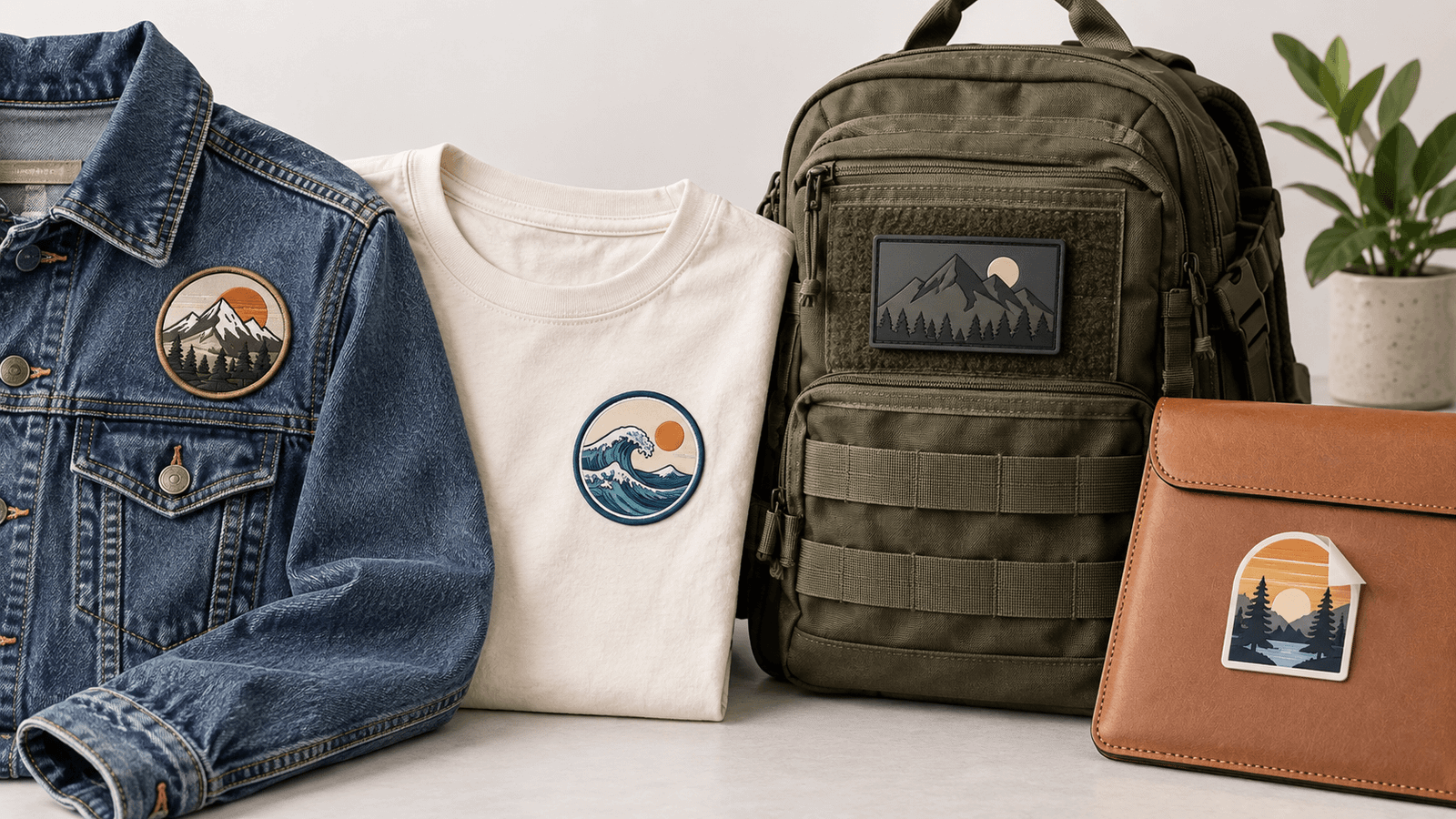
Patch backing is the material or attachment system applied to the reverse side of a patch.
It affects how the finished patch connects to another surface.
For example, a patch may be:
- Sewn directly onto a jacket
- Attached using heat
- Connected to a loop panel
- Applied temporarily with adhesive
The backing does not usually determine what appears on the front of your patch. Instead, it determines how you will use the finished product.
Choosing the right backing is therefore an important part of designing a patch for real-world use.
Quick Comparison of Patch Backing Types
| Backing Type | Attachment | Removable? | Common Uses |
|---|---|---|---|
| Iron-On | Heat-activated adhesive | Usually no | Clothing, jackets, casual apparel |
| Sew-On | Stitched directly to item | No | Uniforms, jackets, workwear, bags |
| Hook-and-Loop | Attaches to compatible loop panel | Yes | Tactical gear, uniforms, hats, backpacks |
| Adhesive | Peel-and-stick adhesive | Yes / temporary | Displays, samples, temporary applications |
There is no single backing type that works best for every project.
The correct choice depends on where the patch will go and how it will be used.
1. Iron-On Patch Backing
Iron-on backing uses a heat-activated adhesive layer on the reverse side of the patch.
When the correct combination of heat and pressure is applied, the adhesive bonds the patch to a compatible fabric.
This makes iron-on patches popular when someone wants a relatively convenient application method without immediately sewing around the patch.
How Does Iron-On Backing Work?
The backing contains adhesive designed to activate when heated.
The general process involves:
- Positioning the patch on the garment.
- Applying controlled heat.
- Applying pressure for the recommended amount of time.
- Allowing the patch and garment to cool.
The exact temperature, pressure, and application time can vary depending on the patch and garment.
Always follow the specific application instructions provided with your patch.
What Are Iron-On Patches Good For?
Iron-on backing can work well for compatible:
- Jackets
- Shirts
- Denim
- Uniforms
- Workwear
- Tote bags
- Casual apparel
- Promotional clothing
It is especially convenient when you want a relatively quick way to attach a fabric patch.
For apparel projects, explore Custom Clothing Patches and choose a backing that suits the garment.
Advantages of Iron-On Backing
Iron-on patches offer several practical benefits.
Convenient Application
You may be able to attach the patch without sewing it by hand or using a sewing machine.
Clean Appearance
Because visible attachment stitches are not always necessary, the finished application can look clean around the patch edge.
Useful for Multiple Garments
Heat application can be convenient when applying the same patch design to compatible shirts, jackets, uniforms, or merchandise.
Good for Many Fabric Patches
Iron-on backing is commonly associated with fabric-based patches such as Custom Embroidery Patches and other compatible constructions.
Limitations of Iron-On Patches
Iron-on backing is not appropriate for every garment.
Potential concerns include:
- Heat-sensitive fabrics
- Waterproof coatings
- Certain synthetic materials
- Stretch fabrics
- Curved surfaces
- Frequent high-temperature washing
- Heavy daily wear
The garment itself must tolerate the heat required for application.
A patch may support iron-on attachment while the garment underneath does not.
Can Iron-On Patches Be Washed?
Many iron-on patches can remain attached through normal wear and washing when properly applied, but repeated washing and excessive heat can gradually affect the adhesive bond.
Turn the garment inside out before washing when appropriate and avoid unnecessary high heat.
Our Custom Patch Care Guide explains how backing and patch materials affect washing and drying.
For frequently washed uniforms or workwear, sewing around the patch edge may provide additional security.
2. Sew-On Patch Backing
Sew-on attachment is one of the most traditional and dependable ways to secure a patch.
Instead of relying on adhesive, the patch is physically stitched onto the garment or item.
It is commonly used when the patch is expected to remain in one location for a long time.
How Does Sew-On Backing Work?
The patch is positioned on the item and stitching is applied around its edge.
Depending on the patch and project, sewing can be completed:
- By hand
- With a household sewing machine
- With commercial sewing equipment
The stitches physically connect the patch and garment.
What Are Sew-On Patches Best For?
Sew-on attachment is particularly useful for:
- Uniforms
- Work jackets
- Denim jackets
- Backpacks
- Workwear
- Team apparel
- Club jackets
- Motorcycle-style jackets
- Hats
- Frequently washed garments
Because the patch is mechanically attached, sew-on backing is a strong choice when long-term placement matters more than easy removal.
Advantages of Sew-On Patches
Secure Attachment
The patch is held directly to the garment by stitching.
No Heat Required
This is helpful for garments that should not be exposed to the temperatures required for heat application.
Suitable for Frequent Wear
Workwear, uniforms, jackets, and bags that experience regular use are often good candidates for sew-on attachment.
Works With Many Patch Materials
Sew-on attachment can be used with multiple patch styles depending on their construction.
For example, Custom Embroidery Patches, Custom Woven Patches, and some Custom PVC Patches may be used with sew-on attachment depending on the selected configuration.
Limitations of Sew-On Backing
Sew-on attachment does require more installation work than simply peeling off an adhesive layer.
You may need:
- A needle and thread
- A sewing machine
- Professional sewing
- Extra installation time
Removing the patch later also requires carefully removing the stitches.
The process can sometimes leave small needle holes in the garment.
3. Hook-and-Loop Patch Backing
Hook-and-loop backing is designed for patches that need to be attached, removed, changed, or repositioned.
It is widely used for:
- Tactical gear
- Military-style patches
- Morale patches
- Uniforms
- Backpacks
- Plate carriers
- Tactical hats
- Identification patches
Instead of permanently attaching the patch to the garment, the hook side on the patch connects to a compatible loop surface.
How Does Hook-and-Loop Backing Work?
A hook-and-loop system has two complementary surfaces.
One side contains small hooks.
The other contains soft loops.
When pressed together, the hooks grip the loop surface and hold the patch in position.
Pulling the patch away separates the two surfaces.
This allows the same area of clothing or equipment to accept different patches.
Why Choose Hook-and-Loop Backing?
The main advantage is interchangeability.
You can remove one patch and replace it with another without sewing or applying additional heat.
This makes hook-and-loop useful when information changes regularly.
Examples include:
- Name patches
- Unit identifiers
- Role patches
- Team identifiers
- Morale patches
- Event patches
- Flag patches
- Tactical identification
Hook-and-Loop for Tactical and Unit Patches
Hook-and-loop is particularly common on tactical-style clothing and equipment that already includes loop fields.
If you are designing unit or morale patches, read our Army Unit Patches Guide for additional information about patch materials, backing, placement, and design.
Custom PVC Patches are also frequently considered for this type of application because PVC provides a molded construction suited to modern tactical and outdoor designs.
Our PVC Patch Guide explains these applications in more detail.
Advantages of Hook-and-Loop Backing
Removable
The patch does not have to remain permanently attached.
Interchangeable
Multiple patches can be used with the same compatible loop panel.
Fast to Change
No ironing or sewing is required every time the design changes.
Useful for Identification
Names, roles, organizations, teams, or other identifiers can be replaced as required.
Good for Tactical Gear
Many tactical bags, uniforms, hats, and equipment already contain loop panels designed for patches.
Limitations of Hook-and-Loop Backing
Hook-and-loop only works properly when there is a compatible surface to attach it to.
If your jacket, bag, hat, or uniform does not have a loop panel, one may need to be added.
It may also be unnecessary when the patch is intended to remain permanently attached.
4. Adhesive Patch Backing
Adhesive backing uses a pressure-sensitive sticky layer on the rear of the patch.
The protective liner is removed, and the patch can then be pressed onto a suitable surface.
Think of it as a peel-and-stick attachment option.
What Is Adhesive Backing Used For?
Adhesive backing can be useful for:
- Temporary placement
- Product samples
- Displays
- Events
- Promotional applications
- Testing patch position
- Certain accessories
- Surfaces where sewing is impractical
The exact performance depends on the patch, adhesive, surface material, temperature, movement, and intended application.
Is Adhesive Backing Permanent?
Adhesive-backed patches should not automatically be treated as the best permanent solution for heavily used clothing.
Fabric moves, bends, stretches, and is washed.
These conditions can make a simple adhesive bond less suitable than sewing or another attachment method for long-term garment use.
Adhesive backing can be more useful when:
- The application is temporary.
- The surface is appropriate for adhesive.
- The patch does not experience heavy movement.
- Washing is not a major requirement.
For frequently washed apparel, consider whether iron-on or sew-on attachment would better suit the project.
Advantages of Adhesive Backing
Fast Application
Remove the protective layer and press the patch into position.
No Sewing Required
Useful when sewing is impractical or unnecessary.
No Heat Required
The surface does not need to tolerate ironing or heat pressing.
Useful for Temporary Applications
Adhesive can make it easier to position or display patches without permanently modifying an item.
Limitations of Adhesive Backing
Adhesive may be affected by:
- Heat
- Moisture
- Dirt
- Fabric texture
- Repeated movement
- Washing
- Surface contamination
- Repeated removal
The intended use should therefore be considered before selecting adhesive backing.
Iron-On vs. Sew-On Patches
This is one of the most common backing comparisons.
Both options are intended primarily for patches that will remain attached, but they achieve that differently.
| Feature | Iron-On | Sew-On |
|---|---|---|
| Attachment | Heat adhesive | Stitching |
| Heat required | Yes | No |
| Sewing required | No | Yes |
| Permanent use | Suitable | Suitable |
| Easy initial application | Yes, on compatible fabric | Requires sewing |
| Heat-sensitive fabric | Often unsuitable | Better option |
| Frequent washing | Requires care | Often practical |
| Easy removal | No | Possible by removing stitches |
Choose Iron-On When:
- The garment is compatible with heat.
- You want convenient application.
- The patch will be applied to suitable fabric.
- You do not want visible attachment stitching.
Choose Sew-On When:
- You want a secure long-term attachment.
- The garment is washed frequently.
- The material should not be exposed to high heat.
- The patch is used on workwear, uniforms, jackets, or similar items.
Some people also combine both methods by applying a compatible iron-on patch and then reinforcing the edge with stitching.
Hook-and-Loop vs. Sew-On Patches
The main decision here is permanence.
Choose hook-and-loop when you want to change the patch.
Choose sew-on when you want the patch to remain in place.
| Feature | Hook-and-Loop | Sew-On |
|---|---|---|
| Removable | Yes | Not during normal use |
| Interchangeable | Yes | No |
| Requires compatible panel | Yes | No |
| Good for tactical gear | Yes | Yes |
| Permanent | No | Yes |
| Quick patch changes | Yes | No |
For tactical hats and other headwear, our Custom Hat Patches Guide explains how curved construction and loop panels can affect the backing choice.
Iron-On vs. Adhesive Backing
Iron-on and adhesive patches may sound similar because neither necessarily requires sewing, but the attachment systems are very different.
Iron-on backing relies on heat to activate an adhesive bond with compatible fabric.
Adhesive backing generally uses pressure-sensitive adhesive that is exposed when a protective liner is removed.
As a result, they suit different applications.
Iron-on backing is generally intended for fabric applications where a stronger attachment is desired.
Adhesive is more useful when convenience or temporary placement matters.
Which Backing Is Best for Clothing?
For everyday clothing, the most common choices are generally:
- Iron-on
- Sew-on
Hook-and-loop can also work when the garment includes a compatible panel and the patch needs to be removable.
Adhesive backing may be more appropriate for temporary applications than frequently washed apparel.
Explore Custom Clothing Patches if your main application is jackets, uniforms, shirts, hoodies, workwear, or fashion apparel.
Which Backing Is Best for Jackets?
The answer depends on the jacket.
Denim Jackets
Sew-on or compatible iron-on patches are common options.
Denim provides a relatively structured surface that can support many patch types.
Work Jackets
Sew-on attachment can be useful where durability and frequent wear matter.
Tactical Jackets
Hook-and-loop works well when the jacket already contains loop fields and patches need to be changed.
Fashion Jackets
Iron-on or sew-on attachment can be selected depending on the garment material and desired appearance.
Always check the garment’s care label before applying heat.
Which Backing Is Best for Hats?
Hat backing requires extra consideration because caps and other headwear have curved surfaces.
Sew-on backing provides a permanent option.
Hook-and-loop works particularly well for compatible tactical hats.
Heat application may also be possible on certain hats, although the shape and material can make consistent pressure more difficult than on a flat garment.
For detailed recommendations, read the Custom Hat Patches Guide.
Which Backing Is Best for Backpacks?
Backpacks can work with several patch attachment methods.
Hook-and-Loop
Ideal if the backpack already has a loop panel and you want interchangeable patches.
Sew-On
Useful when the patch should remain permanently attached.
Adhesive
May work for certain temporary applications, although bag materials, coatings, texture, and movement can affect adhesion.
Check the backpack material before sewing, heating, or applying adhesive.
Which Backing Is Best for Uniforms?
Uniform patches generally require reliable positioning and consistent placement.
Sew-on backing is useful when:
- The patch should remain permanent.
- The uniform receives frequent wear.
- Consistent positioning matters.
Hook-and-loop is useful when:
- Names change.
- Roles change.
- Unit identifiers are interchangeable.
- The uniform already has loop fields.
Iron-on backing may also work with compatible uniform materials when heat application is appropriate.
Choosing Backing for Embroidered Patches
Custom Embroidery Patches provide a traditional raised thread texture and can be used across jackets, uniforms, clothing, hats, and other applications.
Depending on the selected configuration, suitable backing options may include:
- Iron-on
- Sew-on
- Hook-and-loop
- Other available options
Consider the application before choosing.
A corporate jacket that will keep one permanent logo may benefit from a different backing than a tactical uniform where identifiers need to change.
Choosing Backing for Woven Patches
Custom Woven Patches use fine woven threads and are useful for designs containing smaller lettering and intricate detail.
Common attachment approaches can include:
- Sew-on
- Iron-on
- Hook-and-loop
- Adhesive for suitable applications
If you are still deciding between woven and embroidery, read our Woven vs. Embroidered Patches Guide.
The article compares not only appearance and detail but also backing compatibility.
Choosing Backing for PVC Patches
Custom PVC Patches have a flexible molded construction rather than a thread surface.
Common backing choices for suitable PVC applications include:
- Hook-and-loop
- Sew-on
- Adhesive
Hook-and-loop is especially useful for removable PVC patches used on:
- Tactical gear
- Uniforms
- Bags
- Backpacks
- Equipment
- Compatible hats
For more information about PVC construction and customization, read Why Choose PVC Patches?.
You can also compare their backing and performance characteristics with embroidery in PVC vs. Embroidered Patches.
Does Patch Backing Affect Washing?
Yes.
The backing can influence how you should care for a patched garment.
Sew-On Patches
Because the patch is physically stitched onto the garment, sew-on attachment generally handles repeated garment use well.
However, the patch material itself should still be cared for properly.
Iron-On Patches
Repeated washing and excessive heat can eventually affect adhesive.
Avoid unnecessarily high dryer temperatures and follow the patch and garment care instructions.
Hook-and-Loop Patches
When possible, removable hook-and-loop patches can be detached before washing.
This can reduce unnecessary wear on both the patch and fastening surface.
Adhesive Patches
Repeated laundering may not be appropriate for many pressure-sensitive adhesive applications.
If the garment will be washed regularly, choose the backing with that use in mind.
See our complete Guide to Washing and Caring for Custom Patches for more detailed maintenance advice.
Does Patch Backing Affect the Patch Design?
Usually, the backing does not significantly change the artwork visible on the front.
However, the intended attachment can affect practical design decisions.
For example:
Hook-and-Loop Patch
The backing normally needs to work with the overall patch dimensions and shape.
Sew-On Patch
The patch should have an edge suitable for secure stitching.
Iron-On Patch
The patch and garment need to support appropriate heat application.
Adhesive Patch
The shape and application surface can influence how effectively the patch makes contact.
This is why backing should be considered during the design process rather than after production.
If you are still preparing your logo or artwork, see our How to Prepare Artwork for Custom Patches guide before submitting the design.
What Should You Consider Before Choosing Patch Backing?
Ask these questions before ordering.
1. Where Will the Patch Be Used?
Is it going on:
- Clothing?
- Uniform?
- Hat?
- Backpack?
- Jacket?
- Tactical vest?
- Workwear?
- Promotional item?
The application often eliminates unsuitable backing options immediately.
2. Should the Patch Be Removable?
If yes, hook-and-loop is likely worth considering.
If no, sew-on or compatible iron-on attachment may make more sense.
3. Will the Item Be Washed Frequently?
Uniforms, workwear, shirts, and jackets may require a backing suited to repeated laundering.
Read our Patch Care Guide before choosing an attachment method for frequently washed apparel.
4. Can the Material Handle Heat?
Do not choose iron-on backing without checking the garment.
Synthetic fabrics, waterproof treatments, coated materials, and other heat-sensitive surfaces may require another option.
5. Does the Item Already Have a Loop Panel?
If yes, hook-and-loop patches can provide an easy interchangeable solution.
6. Is the Application Temporary?
Adhesive backing may be more appropriate when the patch only needs to remain in place temporarily.
7. What Patch Material Are You Ordering?
Not every backing option is necessarily suitable for every patch construction.
Choose the patch style first, then confirm the compatible backing options.
You can compare available materials through the main Custom Patches collection.
Patch Backing Selection by Use Case
| Application | Backing to Consider |
|---|---|
| Everyday jacket | Sew-on or compatible iron-on |
| Work uniform | Sew-on |
| Tactical uniform | Hook-and-loop |
| Morale patch | Hook-and-loop |
| Backpack with loop panel | Hook-and-loop |
| Denim jacket | Sew-on or compatible iron-on |
| Promotional apparel | Iron-on |
| Temporary display | Adhesive |
| Frequently washed garment | Sew-on |
| Tactical hat | Hook-and-loop |
| Permanent hat patch | Sew-on |
| Replaceable name patch | Hook-and-loop |
These are general recommendations rather than rigid rules. The garment, patch material, surface construction, and manufacturer requirements should always be considered.
Common Patch Backing Mistakes
Choosing Iron-On Without Checking the Fabric
Not every fabric tolerates heat.
Always check the garment care instructions.
Using Adhesive When Permanent Attachment Is Required
Pressure-sensitive adhesive may not be the best solution for frequently washed or heavily used clothing.
Choosing Sew-On When the Patch Needs to Change Regularly
If names, roles, or patch designs need frequent replacement, hook-and-loop may be more practical.
Ignoring Washing Requirements
Consider how often the garment will be washed before choosing the backing.
Assuming Every Backing Works With Every Patch
Backing compatibility depends on patch construction and available customization options.
Ignoring the Surface Shape
Flat jackets, curved hats, textured backpacks, and tactical equipment all behave differently during patch attachment.
How to Choose the Right Patch Backing
A simple way to decide is:
Choose iron-on when you want convenient heat application on a compatible fabric.
Choose sew-on when you want secure, long-term attachment.
Choose hook-and-loop when you need the patch to be removable or interchangeable.
Choose adhesive when you need quick or temporary attachment without sewing or heat.
Then confirm that your chosen backing is compatible with the patch material and item you plan to customize.
Order Custom Patches With the Right Backing
Backing is not just an extra option added at the end of an order.
It affects how your patch will be installed, how it performs in everyday use, whether it can be removed, and how the patched item should be maintained.
Start by choosing the patch style that fits your design.
PatchesOrder offers Custom Patches in multiple constructions, including:
- Custom Embroidery Patches
- Custom Woven Patches
- Custom PVC Patches
- Custom Chenille Patches
- Custom Leather Patches
- Custom Sublimation Patches
Then choose the dimensions, shape, colors, border, and compatible backing for your intended application.
For apparel projects, you can also explore Custom Clothing Patches.
Ready to create your patches?
Request a Free Quote from PatchesOrder.
Frequently Asked Questions About Patch Backing
What is the best backing for custom patches?
There is no single best backing for every patch. Sew-on backing is useful for permanent attachment, iron-on provides convenient heat application on compatible fabrics, hook-and-loop allows patches to be removed or replaced, and adhesive backing can work for temporary or suitable peel-and-stick applications.
What is the strongest patch backing?
For clothing where long-term attachment is required, sewing physically secures the patch to the garment and is commonly used for uniforms, jackets, workwear, and other frequently used items. The best option still depends on the patch and garment.
Are iron-on or sew-on patches better?
Iron-on patches are convenient when the garment supports heat application. Sew-on patches are useful when you want a secure attachment without relying on heat-activated adhesive. The better choice depends on garment material, washing frequency, and intended use.
Can iron-on patches also be sewn?
In many cases, a compatible fabric patch can be reinforced by stitching around its edge after heat application. Confirm that the patch construction and garment are suitable before doing so.
What backing should I choose for a jacket?
Sew-on and compatible iron-on backing are common choices for jackets. Hook-and-loop is useful for tactical or other jackets that already contain loop panels and require interchangeable patches.
What backing should I choose for a uniform?
Choose sew-on when the patch should remain permanently attached. Hook-and-loop can be more practical when names, roles, units, or identifiers need to change.
What is hook-and-loop patch backing?
Hook-and-loop backing uses small hooks on one surface and loops on another. Pressing the surfaces together attaches the patch, while pulling them apart allows the patch to be removed and replaced.
Is hook-and-loop backing good for tactical patches?
Yes. Hook-and-loop is commonly used for tactical-style patches because compatible uniforms, hats, bags, and equipment often include loop fields designed for removable patches.
Are adhesive-backed patches permanent?
Adhesive backing can be useful for temporary and suitable peel-and-stick applications, but it should not automatically be treated as the best permanent solution for frequently washed or heavily used clothing.
Can adhesive patches be washed?
Washing can affect pressure-sensitive adhesive. If the patch is intended for a garment that will be washed regularly, consider a more suitable permanent attachment such as sewing or a compatible heat-applied option.
Can hook-and-loop patches be washed?
When possible, remove hook-and-loop patches before washing the garment or equipment. This can reduce friction and unnecessary wear. Follow the care instructions for both the patch and the item.
Does every patch type support every backing?
No. Backing availability and compatibility can depend on the patch material, construction, application surface, and selected configuration. Confirm the available backing when ordering your specific patch type.
