

A patch and a woven label can both carry a brand name or logo, but they usually do different jobs.
Choose a patch when the element is meant to be seen as part of the garment design—such as an exterior logo, sleeve badge, chest emblem, back graphic, or decorative brand mark.
Choose a woven label when the element is mainly for garment identification—such as a brand name, size, care details, product information, or a discreet internal branding element.
The easiest way to decide is to ask:
Is this element part of the visual design, or part of the garment information system?
If you are still comparing patch materials and apparel uses, start with the Clothing Patch Guide.
The Short Answer: Patch or Woven Label?
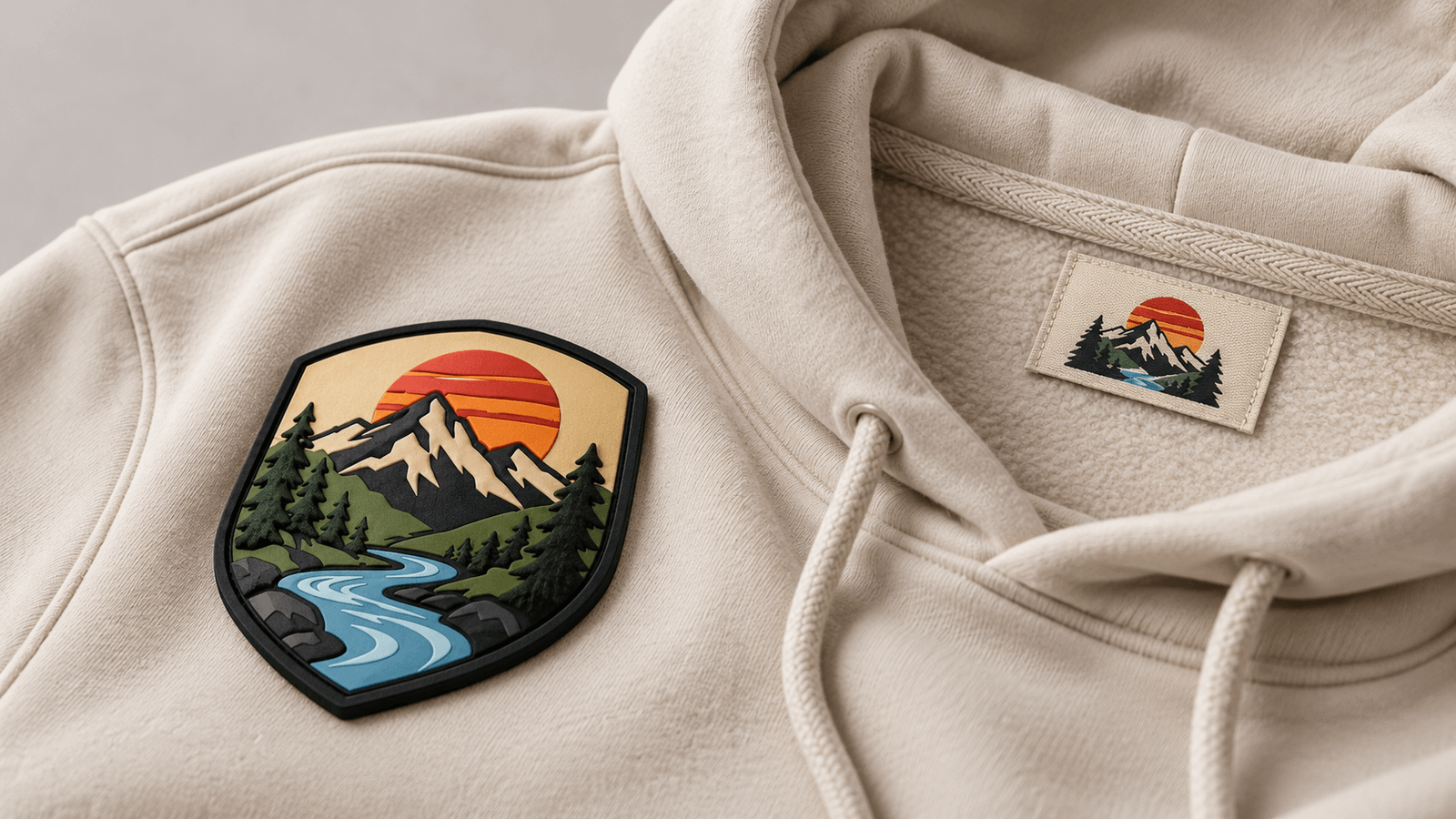
Use a patch when you want the customer to notice the element from the outside.
Use a woven label when the information should stay compact, lightweight, and closely integrated into the garment.
A clothing brand may need both.
For example:
- Exterior embroidered logo patch
- Interior woven brand label
- Separate size label
- Care label
- Limited-edition sleeve patch
These pieces are not competing with one another. They perform different roles.
Patch vs Woven Label: Quick Comparison
| Feature | Patch | Woven Label |
|---|---|---|
| Main role | Decorative or visible identity | Garment identification |
| Typical placement | Exterior | Interior or discreet exterior |
| Thickness | Usually more substantial | Usually thinner and flatter |
| Information density | Better for simple, bold designs | Better for compact text and brand details |
| Logo visibility | High | Usually subtle |
| Care information | Usually not ideal | More suitable |
| Size information | Rare | Common |
| Decorative use | Strong | Limited |
| Garment attachment | Sew-on, heat-applied, hook-and-loop or other suitable method | Usually sewn into or onto garment |
| Best for | Logos, artwork, emblems, graphics | Brand, size, care, product information |
The right choice depends on what the element is supposed to communicate.
Think About the Job Before the Material
Many brands begin with the wrong question:
“Should this be embroidered or woven?”
A better first question is:
“What job does this element need to perform?”
Imagine a streetwear hoodie.
You may need:
- Large back artwork
- Small sleeve logo
- Interior neck branding
- Size information
- Care details
One product can require several different identity elements.
The large back graphic may work as a patch.
The neck branding may work better as a woven label.
Size and care information may need separate labels depending on the garment design and required information.
Thinking in roles creates a cleaner product system.
When a Patch Makes More Sense
A patch is usually the stronger choice when visibility is intentional.
Exterior Brand Identity
Patches work well for:
- Chest logos
- Sleeve emblems
- Jacket branding
- Hat graphics
- Back designs
- Club-style badges
They add texture and dimension that can become part of the garment’s visual character.
Decorative Artwork
A patch does not have to contain a company name.
It can also carry:
- Illustration
- Mascot
- Symbol
- Seasonal graphic
- Collection mark
- Limited-edition artwork
This makes patches particularly useful for fashion collections where the branding element is meant to function as design.
Collection-Specific Details
A brand may keep its internal woven label unchanged while rotating decorative patches across different drops.
For example:
Core label: Same brand identity every season
Exterior patch: New graphic for each collection
That keeps the brand consistent while allowing the product design to evolve.
Explore Custom Clothing Patches if your priority is an exterior decorative or branding element.
When a Woven Label Makes More Sense
Woven labels are better suited to compact garment information.
Common uses include:
- Brand name
- Logo
- Size
- Product identification
- Collection name
- Care-related information where appropriate
- Origin or other garment information where required
Because they are generally thinner and flatter than decorative patches, they can integrate more discreetly into the garment.
PatchesOrder offers Custom Labels and Tags for clothing and product branding applications.
Placement Is One of the Clearest Differences
Ask where the element needs to live.
Typical Patch Placement
Patches are often placed on:
- Left chest
- Right chest
- Sleeve
- Shoulder
- Jacket back
- Hat front
- Bag exterior
These are visible positions.
Typical Label Placement
Woven labels often appear:
- Inside neckline
- Side seam
- Waistband
- Hem
- Sleeve edge
- Interior garment panel
A label can also be used visibly on the outside, but its design role is usually more subtle.
Placement therefore gives you an immediate clue.
If the element needs to be a focal point, think patch.
If it needs to identify the garment quietly, think label.
Thickness Changes the Garment Feel
Thickness matters more than many buyers expect.
A patch usually creates more physical presence.
That can be useful on:
- Jackets
- Denim
- Workwear
- Hoodies
- Hats
- Bags
A woven label usually sits flatter and creates less bulk.
That can be better for:
- Neck branding
- Lightweight shirts
- Side seams
- Interior garment identification
- Small product details
The garment itself should guide the decision.
A heavy decorative patch may feel appropriate on denim but unnecessary inside the collar of a lightweight T-shirt.
Information Density: How Much Needs to Fit?
Patches usually work best when the message is visually simple.
Good patch content often includes:
- Logo
- Short brand name
- Symbol
- Number
- Short phrase
- Graphic
A woven label can handle more compact information because the format is designed for smaller textile details.
This makes it more suitable when the element needs to communicate several pieces of garment information.
If you are trying to fit:
- Brand name
- Size
- Care wording
- Product line
- Additional text
onto a decorative patch, the design is probably doing too many jobs.
Split the functions instead.
Branding Can Be Loud or Quiet
A patch creates visible branding.
A woven label creates embedded branding.
Both can be valuable.
Visible Branding
Use when you want the brand to contribute directly to the outfit.
Examples:
- Streetwear sleeve patch
- Workwear chest emblem
- Denim waistband patch
- Hat logo patch
Embedded Branding
Use when the brand should be present without becoming the main visual feature.
Examples:
- Neck label
- Side-seam label
- Interior brand tag
Many apparel brands use both approaches intentionally.
Care Information Belongs in the Right Format
Care information is functional.
It should not be squeezed into a decorative patch just because the patch already contains the brand name.
If the garment requires:
- Washing instructions
- Fiber information
- Size details
- Product information
use a label format designed to carry that information clearly.
Also make sure any legally required garment labeling information is handled according to the relevant regulations for your market. A patch supplier should not be treated as the source of legal compliance advice for textile labeling.
Attachment Is Different Too
Patches can use several attachment methods depending on the garment and use.
These can include:
- Sew-on
- Iron-on
- Hook-and-loop
- Other suitable attachment methods
Labels are usually incorporated more directly into the garment construction.
They may be:
- Sewn into a seam
- Sewn flat onto fabric
- Folded and sewn at the edges
- Attached at the neckline or waistband
The exact label construction depends on the garment and label style.
This is another reason labels are usually treated as garment components, while patches are often treated as design features.
Can a Woven Patch Replace a Woven Label?
Sometimes they can look similar, but they should not automatically be treated as interchangeable.
A woven patch is typically:
- More decorative
- More visible
- Built as a separate exterior element
- Used like a badge or emblem
A woven label is usually:
- Thinner
- More integrated into garment construction
- Designed for branding or product information
- Used in necklines, seams, hems, or other garment locations
The construction and intended role matter more than the fact that both use woven thread.
Can a Brand Use Both on the Same Product?
Yes, and this is often the best approach.
Consider a premium hoodie:
Exterior chest: Small embroidered logo patch
Sleeve: Seasonal decorative patch
Inside neck: Woven brand label
Side seam: Size or product label
Each component has a clear role.
The customer experiences one coordinated brand system rather than one overloaded branding element.
A Simple Decision Framework
Ask these questions in order.
1. Should the customer notice it from the outside?
Yes → Consider a patch.
No → Consider a label.
2. Does it need to carry functional garment information?
Yes → A woven label is usually more appropriate.
No → Continue evaluating the visual role.
3. Is texture part of the design?
Yes → A decorative patch may add more character.
No → A flatter label may be enough.
4. Will the element change by collection?
Yes → A patch can work well as a seasonal or limited-edition feature.
No → A permanent brand label may provide better continuity.
5. Does the garment need both identification and decoration?
Yes → Use both instead of forcing one element to handle both jobs.
What Clothing Brands Should Standardize
Whatever you choose, record the specification.
For patches, save:
- Artwork
- Dimensions
- Material
- Colors
- Border
- Backing
- Placement
For labels, save:
- Artwork
- Dimensions
- Wording
- Color treatment
- Fold or attachment style where applicable
- Placement
This becomes especially important across multiple production runs.
Without records, small visual changes can creep into later orders.
Avoid These Common Decisions
Do not choose a patch simply because it feels more premium.
Do not choose a woven label simply because it is smaller.
Do not place care information into a decorative exterior badge.
Do not turn a bold collection graphic into a tiny neck label.
Do not assume one element must solve every branding problem.
Start with function, then choose the format.
Which Does Your Brand Need?
Choose a patch when your goal is visible identity, texture, decoration, or collection-specific design.
Choose a woven label when your goal is product identification, brand information, size details, care information, or discreet garment branding.
And if the garment needs both visual branding and functional identification, use both.
That usually creates a stronger system than trying to make one element do everything.
Explore Custom Clothing Patches for decorative exterior applications, or view Custom Labels and Tags for garment branding and product-identification options.
Ready to develop your garment branding system? Request a free quote with your artwork, garment type, intended placement, dimensions, quantity, and whether you need a decorative patch, woven label, or both.
Frequently Asked Questions
What is the main difference between a patch and a woven label?
A patch is usually a visible decorative or branding element, while a woven label is usually a thinner garment-identification element used for brand, size, care, or product information.
Are woven patches the same as woven labels?
No. They may use similar textile construction, but woven patches are generally designed as exterior decorative pieces, while woven labels are intended to integrate into the garment.
Should a clothing brand use a patch or label for its logo?
It depends on the role. Use a patch when the logo should be visually prominent. Use a woven label when the logo is part of the garment’s internal or discreet brand identification.
Can care information go on a patch?
It is usually better to place care information on a garment label designed for functional product details rather than on a decorative patch.
Can I use both a patch and woven label on one garment?
Yes. A brand can use a decorative exterior patch and separate woven labels for brand identity, size, care, or other product information.
Which option is better for streetwear?
Streetwear brands often use patches for visible design details and woven labels for internal brand and garment information. The right combination depends on the collection and garment.
