

Custom name patches give workwear and uniforms a clear way to identify employees without redesigning the entire garment for each person.
A good embroidered name-patch program should answer five questions before ordering: What should the patch say? How should names and roles be formatted? What size should remain consistent across the team? Where should each patch sit? And how will new employees or replacements be reordered later?
Getting those decisions right at the beginning makes personalized orders easier to approve and easier to repeat.
For broader guidance on embroidery construction, artwork, coverage, and backing, see the Custom Embroidered Patch Guide.
Start With the Information the Patch Needs to Show
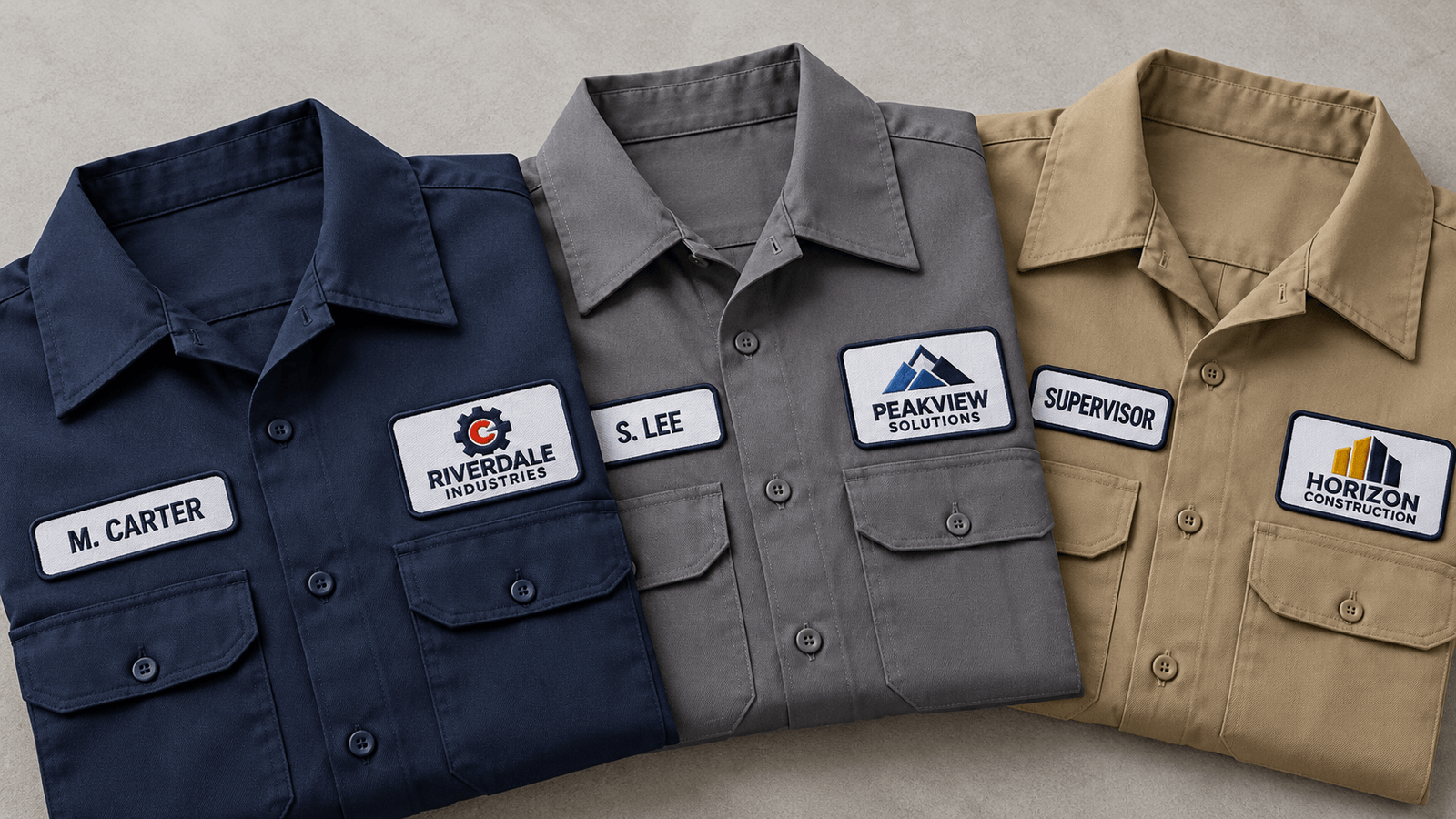
A name patch does not need to carry every detail about the employee.
Its main job is usually identification.
A patch might contain:
- First name
- Last name
- First initial and last name
- Employee number
- Role
- Department
- Name plus role
Keep the information hierarchy simple.
For example:
J. CARTER
is easier to read quickly than:
JONATHAN CARTER – SENIOR FIELD SERVICE TECHNICIAN
If the job title matters, consider separating the name and role rather than forcing everything into one small patch.
Decide Whether Names and Roles Belong Together
There are two common approaches.
Name Only
Examples:
MILLER
A. RODRIGUEZ
SARAH
This works well when the organization logo or department information already appears elsewhere on the uniform.
Name Plus Role
Examples:
MILLER
SUPERVISOR
or:
J. CARTER – TECHNICIAN
This can work when role identification is important, but longer wording needs more space.
Before combining them, ask whether the employee’s role is likely to change.
If promotions or department moves are common, keeping the role separate may make future updates easier.
Create One Naming Format for the Whole Team
Consistency matters more than whether you choose full names or initials.
Do not mix formats such as:
JOHN SMITH
M. CARTER
ALEX
unless there is an intentional reason.
Choose a format before building the roster.
Possible standards include:
- First name only
- Last name only
- First initial + last name
- Full first and last name
Then decide:
- All caps or title case
- Font style
- Text alignment
- Background color
- Thread color
- Border color
One approved format gives the entire group a more organized appearance.
Design Around the Longest Names
One of the easiest mistakes is approving the patch using a short sample name.
LEE fits almost anywhere.
MONTGOMERY does not.
Before approving the dimensions, test several realistic extremes:
- Shortest name
- Longest name
- Name with wide letters
- Name with initials
- Longest role or department wording
The goal is to avoid making every employee patch a different physical size.
Keeping a consistent outer patch shape generally creates a cleaner uniform system.
If some names become too long, options can include:
- Adjusting letter spacing
- Using an approved abbreviation
- Using an initial
- Increasing the standard patch width
- Simplifying the wording
Readability should remain the priority.
Keep the Patch Size Consistent
Name patches often look better when everyone receives the same basic dimensions.
Imagine a crew where one name patch is narrow, another is wide, and a third is unusually tall.
Even if every patch is readable, the uniform system can look inconsistent.
A standard patch size gives you predictable:
- Placement
- Alignment
- Border treatment
- Name formatting
- Future reorders
Choose the dimensions after considering the longest expected name and the available space on the garment.
Build the Roster Before Requesting Production
Personalized patch orders should not be managed through scattered emails or chat messages.
Create one master roster.
Useful columns include:
- Employee name
- Exact patch text
- Role
- Department
- Quantity
- Garment type
- Notes
- Approval status
The most important column is Exact Patch Text.
For example:
| Employee Record | Exact Patch Text | Role |
|---|---|---|
| Jonathan Carter | J. CARTER | Technician |
| Samantha Lee | S. LEE | Supervisor |
| Michael Rodriguez | M. RODRIGUEZ | Service |
The employee record and the text actually embroidered are not always identical.
Separating them prevents interpretation mistakes.
Treat Spelling Approval as a Separate Step
A correctly designed patch with a misspelled name is still unusable.
Before approval, review every variable field.
Check:
- Spelling
- Initials
- Hyphens
- Apostrophes
- Numbers
- Titles
- Abbreviations
Names such as:
O’NEILL
SMITH-JONES
McCARTHY
deserve particular attention because formatting may vary between source records.
Do not ask the patch supplier to decide which version is correct.
The organization ordering the patches should supply and approve the final wording.
For larger rosters, having a second person review the list can help catch errors before approval.
Choose Colors for Readability First
Name patches are functional.
The wearer should not need someone standing inches away to read the name.
Strong contrast combinations generally work better than similar tones.
For example, light lettering on a dark base often produces clearer separation than two closely related dark colors.
If brand colors are required, review how the text color, background, and border interact.
For more on physical thread and fabric color, see our Thread and Twill Color Matching Guide.
Choose a Backing Around How the Uniform Is Used
The attachment method should match the garment and whether the employee patch needs to change.
Sew-On for Permanent Name Patches
Sew-on can be a practical choice when the patch should remain attached to the same work shirt or jacket.
It can suit frequently worn garments where permanent placement is preferred.
Hook-and-Loop for Changeable Identification
Hook-and-loop makes more sense when:
- Employees move between garments
- Names need to be changed
- Uniforms already have loop panels
- Roles or assignments change
- Patches must be removed
This can reduce the need to permanently attach every personalized patch to every garment.
Iron-On or Heat-Seal Where Suitable
Heat application can be convenient, but the garment must tolerate the required heat and pressure.
Do not choose this backing until the garment fabric and care instructions have been checked.
The Patch Backing Types Guide compares these attachment approaches in more detail.
Place Name Patches Consistently
A name patch should not move noticeably from one employee’s shirt to another.
Common locations include:
- Above a chest pocket
- Opposite the company logo
- Left or right chest
- Designated uniform panel
Use a repeatable garment reference such as:
- Pocket edge
- Center placket
- Zipper
- Shoulder seam
rather than placing every patch by eye.
If the company logo is on one side and the employee name is on the other, check their visual alignment together.
For detailed placement planning, use the Patch Placement Guide.
Coordinate Name Patches With the Rest of the Uniform
A name patch is usually one part of a larger identification system.
Other uniform elements may include:
- Company logo
- Department patch
- Role identifier
- Location
- Safety markings
- Organization emblem
The name should remain easy to locate without competing with every other element.
For broader planning around hierarchy and uniform identification, see Uniform Patches: Design and Placement Checklist.
Plan New-Hire Patches Before You Need Them
A personalized patch system should continue working after the first roster is delivered.
Employees join.
People leave.
Uniforms are replaced.
Departments change.
Save the approved format so a new name can be added without rebuilding the design.
Your record should include:
- Patch dimensions
- Background color
- Thread color
- Font or approved lettering style
- Border
- Backing
- Placement
- Capitalization format
- Approved proof or reference
Then a new order becomes:
Use approved NAME-PATCH-01 format with the following new names
rather than:
Can you make something that looks like our old patches?
Keep Reorders Controlled
The easiest way for a uniform program to drift visually is through untracked reorders.
A different person may submit the next order six months later and accidentally change:
- Patch size
- Font
- Blue shade
- Border
- Backing
- Name format
Create a simple internal reference for the approved design.
For example:
NAME-NAVY-WHITE-01
Keep that reference with the artwork and specifications.
When ordering replacements, specify what has changed—usually only the employee name and quantity.
Name Patch Ordering Checklist
Before requesting a quote, confirm:
- Name format is standardized
- Role format is standardized if used
- Longest names have been tested
- One patch size is approved
- Exact roster wording is complete
- Names have been proofread
- Thread and background colors are approved
- Backing suits the garment
- Placement is documented
- Main proof is approved
- Individual variations have been reviewed
- Reorder specifications are saved
Make Personalized Workwear Easier to Manage
Custom name patches work best when personalization happens inside a controlled system.
Choose one naming format. Build the patch around the longest realistic name. Keep dimensions, typography, colors, and backing consistent. Maintain one approved roster and check every spelling before production.
Then save the design specification.
That final step turns future employee additions and replacement uniforms into simple reorders instead of new design projects.
PatchesOrder offers Custom Embroidery Patches for names, uniforms, jackets, workwear, businesses, teams, and other branded apparel.
Ready to prepare employee name patches? Request a free quote with your roster, preferred dimensions, quantity, colors, backing, and intended uniform application.
Frequently Asked Questions About Custom Name Patches
What information can go on an embroidered name patch?
A name patch can include a first name, last name, initials, employee number, role, or department. Keep the wording short enough to remain readable at the intended size.
Should every employee name patch be the same size?
Using consistent dimensions usually creates a cleaner uniform system. Test the proposed size against the longest names before final approval.
How should I submit a list of employee names?
Use one organized spreadsheet or roster with a column showing the exact text that should appear on each patch. Include quantities and roles or departments where relevant.
What backing works best for workwear name patches?
Sew-on works well for permanent attachment, hook-and-loop suits removable or interchangeable identification, and heat-applied options may work on compatible fabrics. Choose according to the garment and use.
Where should an employee name patch go?
Common positions include above a chest pocket or opposite the company logo. Use consistent garment reference points and follow any placement rules required by the organization.
How can I make future employee name patches match the originals?
Save the approved dimensions, lettering format, colors, backing, placement, and proof. Use that specification when ordering names for new employees or replacement garments.
