A patch’s border does more than frame the design. It affects the finished shape, the thickness around the edge and how much room remains for your artwork. When comparing patch border types, the main difference is straightforward: a merrowed border wraps thread around the perimeter to create a raised rim, while a heat-cut edge follows the outline with a flatter finish.
Merrowed borders often suit traditional badges with simple shapes. Heat-cut edges are useful when a patch needs to follow a more detailed silhouette. The right choice depends on your artwork, patch material, finished size and intended placement.
Before choosing an edge, review our custom patch design guide to plan the shape, lettering and layout together. A border works best when it is part of the original design rather than an afterthought.
What Is a Merrowed Border?
A merrowed border is a stitched edge that wraps around the outside of a fabric patch. An overlock-style edging process covers the perimeter with thread, creating a rounded, cord-like frame.
The edging is generally added after the main design is completed and the patch is cut to shape. It encloses the fabric edge, helps contain loose fibers and gives the patch a clearly defined outline.
A Raised Frame With a Traditional Look
The easiest way to recognize a merrowed patch is by its substantial thread rim. The border rises above the patch surface and creates a noticeable transition between the patch and the garment.
A contrasting thread color makes that frame more prominent. For example, a light border around a dark patch can help separate the design from a navy jacket. A matching border color creates a more understated finish.
This edging is often a good visual fit for uniform emblems, club badges, school patches and name patches.
Where Merrowed Edging Works Best
Circles, ovals, rectangles and other manageable outlines are common candidates. Broad curves and open corners give the edging process a more straightforward path around the patch.
More complicated shapes need individual review. A large shield may be manageable, while a small mascot with narrow ears, deep recesses or thin projecting details may need adjustments.
Merrowed edging does not make every custom shape impossible. However, the border must have enough room to follow the contour without crowding or distorting it.
What Is a Heat-Cut Edge?
A heat-cut edge is formed by cutting the patch perimeter using a heated tool or another suitable thermal process. On compatible synthetic fabrics, the heat can fuse fibers along the cut line to help control fraying.
The cutting process does not add a wrapped thread rim. This generally produces a lower-profile perimeter and allows the finished patch to follow its design more closely.
Material compatibility matters. Different fabrics react differently to heat, so a clean, stable edge depends on the selected material and manufacturing process.
Why Detailed Shapes Often Suit a Cut Edge
A heat-cut outline can follow the contours of a mountain, mascot, vehicle or other irregular design without surrounding everything with a thick, rounded frame.
That flexibility is useful when the silhouette helps people recognize the artwork. A patch shaped around a bird, for example, may benefit from keeping the outline of its wings visible.
However, tiny points and narrow sections still have practical limits. A cutting process can trace a shape without necessarily making every part of that shape strong enough for regular use.
Heat-Cut, Hot-Cut and Laser-Cut: Understanding the Terms
Suppliers may use “heat-cut” and “hot-cut” to describe similar finishes. Laser cutting can also create a close outline and seal compatible materials, but it uses different equipment from a hot knife.
For ordering purposes, describe both the appearance you want and the construction you expect.
Details to Confirm Before Ordering
Ask which cutting process will be used, whether the material is suitable and whether a stitched outline is included. Also confirm how small corners, narrow gaps and exposed fabric will be handled.
These details tell you more about the finished patch than the border name alone.
Merrowed vs Heat-Cut Edges at a Glance
| Feature | Merrowed Border | Heat-Cut Edge |
|---|---|---|
| Construction | Thread wraps around the perimeter | Heat cuts and may seal compatible fabric |
| Visual finish | Rounded, raised thread frame | Closely cut outline with less perimeter bulk |
| Shape suitability | Simple shapes and manageable contours | Irregular silhouettes and more detailed outlines |
| Edge thickness | Adds thickness through wrapped thread | Usually flatter without a wrapped rim |
| Artwork space | Requires room for the stitched frame | Requires cutting clearance and space for any stitched outline |
| Main limitation | Tight recesses and small projections can be difficult | Material compatibility and fragile details need review |
| Attachment | Backing or sewing method selected separately | Backing or sewing method selected separately |
These are typical differences rather than fixed specifications. The finished result depends on the patch material, size, stitching and backing.
Is a Satin-Stitch Border the Same as a Merrowed Border?
A satin-stitch border and a merrowed border can both create a colored frame, but their construction is different.
A satin border consists of closely spaced stitches forming a band on the patch face. Merrowed edging wraps around the outer edge, producing a more rounded rim.
A heat-cut patch may include a satin-stitch outline. In that construction, the stitching creates the visible frame while the cutting process defines the perimeter.
Separate the Outline From the Cutting Method
When reviewing a quote or proof, consider two questions:
- How will the visible border be stitched?
- How will the outside edge be cut and finished?
This distinction helps avoid ordering a plain cut outline when you expected a colored stitched frame. It also makes comparing samples easier when different suppliers use different names for similar finishes.
How Patch Shape Changes the Decision
The outline of your patch should guide the border choice. Look beyond the overall shape and inspect its smallest corners, narrowest connections and deepest inward curves.
Simple Badges and Name Patches
A round team badge or rectangular name patch often works well with merrowed edging. The raised frame reinforces a clear geometric shape and gives the design a familiar badge appearance.
For a small name patch, keep the lettering comfortably inside that frame. A heavy border can make an already narrow layout feel crowded.
Mascots and Irregular Silhouettes
A patch that follows a mascot’s head, a mountain range or a distinctive product shape may benefit from a heat-cut outline.
Review the smallest features carefully. Thin tails, pointed ears and narrow connecting sections may need widening or simplification, especially when the patch is reduced in size.
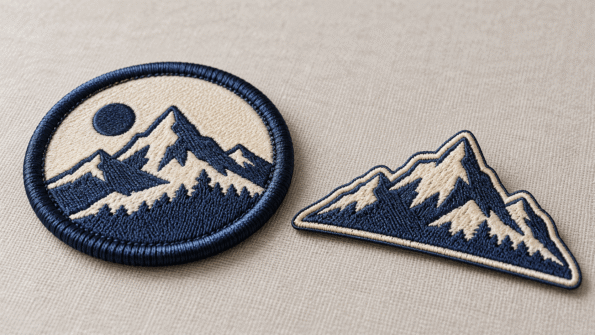
Example: The Same Mountain Design, Two Finishes
Inside a circular patch, a mountain illustration can use a merrowed border to create a traditional outdoor badge.
As a patch shaped around the peaks themselves, a heat-cut outline may preserve the mountain silhouette more effectively. The artwork can stay similar while the border changes the overall character.
Thickness and Artwork Space: What Buyers Often Miss
Border width and border thickness describe different features. Width is the amount of space the border occupies when viewed from above. Thickness is how far it rises from the surface.
Merrowed edging adds both a visible frame and a raised perimeter. A heat-cut edge usually adds less bulk, but the patch itself can still be substantial.
Dense embroidery, backing and additional layers all affect overall thickness. A flatter edge does not automatically create a thin or flexible patch.
Leave Breathing Room Around the Design
Avoid placing lettering or important symbols directly against the border. Allow enough space for the stitched frame, cut line and production tolerances.
There is no single clearance measurement suitable for every patch. The required space depends on the material, size and construction.
For custom embroidered patches, review the thread detail and border together. If small text remains difficult to reproduce, compare custom woven patches. Changing the border alone will not solve every artwork limitation.
Border Finish and Backing Are Separate Choices
The border finishes the patch perimeter. The backing or attachment method determines how the patch connects to clothing or equipment.
A heat-cut patch is not automatically iron-on. Likewise, a merrowed border does not mean a patch must be sewn onto a garment.
Match Attachment to the Application
For a sewn application, confirm where the attachment stitches should sit. For heat-seal backing, check compatibility with the garment and follow the supplied application instructions.
Hook-and-loop attachment introduces another consideration: the patch and backing need to work together without the edging interfering with the usable fastening area.
Choose the edge for the appearance and construction you need, then confirm that the backing supports the intended use.
Five Checks Before Approving Your Patch Border
1. Confirm the Finished Dimensions
Provide the width and height, and ask whether those measurements include the border. View the design at actual size so small lettering and narrow details are easier to judge.
2. Review the Outer Shape
Check inward corners, pointed features and thin connecting areas. Ask whether any part needs to be rounded, widened or simplified for the selected finish.
3. Specify the Border Appearance
Describe whether you want a raised wrapped rim, a flatter stitched frame or a closely cut outline. Include the preferred border color and a reference image when helpful.
4. Check the Complete Construction
Confirm the material, edge treatment and backing together. For PatchesOrder orders, ask which border options are available for your particular design and patch type before approving production.
5. Look Beyond the Digital Proof
A digital proof helps confirm layout, proportions and spelling. It cannot fully communicate the feel or thickness of a stitched edge.
If the border finish is especially important, ask whether a representative close-up or physical sample is available for review.
Frequently Asked Questions
Which Patch Border Is Better for Sharp Corners?
A heat-cut edge is often more practical for sharp corners and detailed contours. Very small points may still need adjustment. The final shape should be reviewed at the requested patch size before production.
Does Heat Cutting Prevent All Fraying?
No. Thermal cutting can help seal compatible synthetic fibers, but the result depends on the material and process. Wear or damage can still affect the perimeter, so a heat-cut finish should not be treated as universally fray-proof.
Can a Heat-Cut Patch Have a Colored Border?
Yes. A separate stitched outline, such as a satin border, can add a colored frame. Confirm whether that stitching is included in the design rather than assuming it comes with the cutting method.
Is a Merrowed Border Always More Durable?
No single edge treatment guarantees greater durability in every application. Merrowed thread encloses the perimeter, but the base fabric, stitching, backing, attachment and care also influence how the patch performs.
Can I Change the Border When Reordering a Patch?
Potentially, but changing the border may alter the overall dimensions, visible artwork space and appearance. Supply the original patch or a clear reference and request an updated proof before approving the revised construction.
Do Leather and PVC Patches Use These Same Borders?
Not necessarily. PVC patches have molded edges, while leather patches use treatments suited to the material and manufacturing process. Merrowed versus heat-cut is primarily a comparison for compatible textile patches.
Give Your Patch the Right Finishing Touch
The right border should support your artwork, fit the finished shape and suit the way the patch will be used. Merrowed edging creates a rounded stitched frame, while a heat-cut finish can follow a closer outline with less bulk around the perimeter.
Share your artwork, dimensions, quantity, intended placement and preferred edge appearance with PatchesOrder. Request a free quote for custom patches and confirm the most suitable border construction for your design.
