Two custom patches can be the same general size and still have different prices.
Why?
Because custom patch pricing is not based on one measurement alone. The final quote can change according to the patch type, dimensions, quantity, artwork complexity, construction, backing, shape, finishing requirements, and other customization choices.
That is why custom patch suppliers usually need to review the actual project before providing an accurate price.
For example, a simple 3-inch embroidered company logo and a detailed 3-inch molded PVC emblem may require very different production processes even though their overall dimensions are similar.
Understanding the main pricing factors can help you:
- Plan your order more effectively
- Compare patch options correctly
- Avoid unnecessary customization
- Prepare better quote information
- Balance appearance, function, and budget
This guide explains what affects custom patch pricing without relying on generic per-piece estimates that may not apply to your design.
If you already know your requirements, you can browse Custom Patches or request a free quote from PatchesOrder.
Why Don’t Custom Patches Have One Fixed Price?
Custom patches are made around individual specifications.
One customer might order a simple embroidered logo for work uniforms.
Another might need a raised PVC emblem for outdoor equipment.
A third may require detailed woven patches with small lettering for branded clothing.
Those products differ in:
- Material
- Manufacturing process
- Dimensions
- Artwork
- Quantity
- Finishing
- Attachment method
As a result, using one universal price for every custom patch would not accurately reflect the production requirements.
A better way to think about pricing is:
Patch Type + Size + Quantity + Design Complexity + Customization = Your Quote
Let’s look at each part.
1. Patch Type Can Affect the Price
The first major factor is the type of patch being produced.
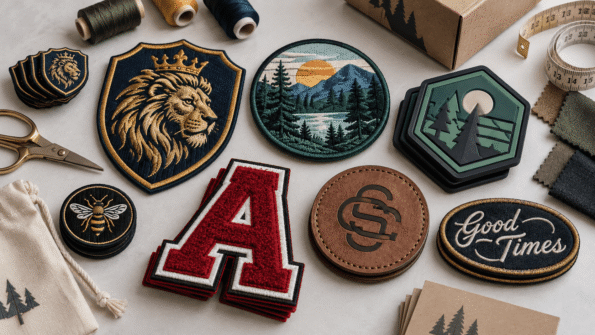
PatchesOrder offers multiple custom patch styles, including:
- Embroidered
- Woven
- PVC
- Chenille
- Leather
- Sublimation
These are not simply different visual styles. They use different materials and manufacturing processes.
That means two patches based on the same logo may have different production requirements depending on which construction you choose.
Embroidered Patches
Custom Embroidery Patches use stitched thread to create a raised, traditional appearance.
Pricing can be influenced by factors such as:
- Patch dimensions
- Amount of stitched detail
- Design complexity
- Quantity
- Backing
- Edge and finishing requirements
A clean logo with bold shapes may have different production requirements from an intricate emblem containing many small stitched elements.
Woven Patches
Custom Woven Patches use finer threads to create a smoother surface and reproduce more detailed artwork.
They are often considered when a design contains:
- Fine lines
- Smaller text
- Detailed branding
- Intricate graphics
The manufacturing approach is different from embroidery, so you should compare the two based on the design rather than assuming they will always cost the same.
Our Woven vs. Embroidered Patches Guide explains the construction differences in more detail.
PVC Patches
Custom PVC Patches use flexible molded material rather than thread.
PVC pricing can be influenced by:
- Overall dimensions
- Number of design layers
- 2D or raised 3D construction
- Artwork complexity
- Quantity
- Backing
- Shape
A simple flat PVC logo and a multi-level raised design should not automatically be expected to have the same production requirements.
Learn more about the material in Why Choose PVC Patches?.
If you are deciding between thread and PVC, see PVC vs. Embroidered Patches.
Chenille Patches
Custom Chenille Patches use thick textured yarn and are commonly associated with varsity-style:
- Letters
- Numbers
- Mascots
- School emblems
- Team designs
Their materials and production method differ from woven or traditionally embroidered patches.
Large chenille letters or jacket designs may therefore need to be quoted according to their specific dimensions and construction.
Leather Patches
Custom Leather Patches use a completely different surface and production style from thread-based patches.
The final requirements may depend on:
- Patch dimensions
- Logo complexity
- Shape
- Leather construction
- Finishing
- Attachment method
- Quantity
Leather patches are often used for hats, denim, fashion apparel, bags, and branded merchandise.
Sublimation Patches
Custom Sublimation Patches use a printed approach suited to detailed and colorful artwork.
Their production requirements differ from embroidered, woven, chenille, PVC, and leather patches.
That is why material choice should come before price comparison.
Compare products that actually meet the same design and application requirements.
2. Patch Size Affects Material and Production Requirements
Size is one of the most obvious pricing factors.
A larger patch generally requires more material and production capacity than a smaller version of the same design.
Consider the difference between:
- A small cap-side logo
- A medium chest patch
- A large jacket-back emblem
Even if all three contain the same artwork, their physical production requirements are different.
However, size should not be considered alone.
A simple 5-inch patch may sometimes be easier to manufacture than a highly intricate 2-inch patch containing extremely small details.
The important point is:
Size and design complexity work together.
Before requesting a quote, provide the actual width and height you need rather than simply describing the patch as “small,” “medium,” or “large.”
3. Order Quantity Changes the Economics of Production
Quantity is another major part of custom patch pricing.
Producing a custom product typically involves preparation before individual pieces are manufactured.
Depending on the patch type, this can include:
- Artwork preparation
- Production setup
- Tooling or machine preparation
- Material preparation
- Color setup
- Quality-control preparation
When more units use the same approved design, that initial production effort can be spread across a larger order.
This is why the total order value and per-patch economics can change as quantity changes.
When requesting your quote, provide the actual quantity you expect to need.
Do not request pricing for 500 pieces if you realistically need 50.
Likewise, if you know you will need additional patches shortly afterward, it can be useful to include that expected quantity when discussing the project.
4. Artwork Complexity Can Influence the Quote
A patch containing one word and a simple icon is not the same manufacturing project as an intricate crest containing:
- Multiple text areas
- Fine lines
- Several symbols
- Detailed borders
- Small numbers
- Multiple visual layers
- Complex shapes
More complicated artwork can require additional preparation or manufacturing consideration.
This does not mean detailed designs are a problem.
It simply means that the design itself is part of the pricing equation.
Simple Artwork Example
Imagine a patch containing:
NORTH CO.
with one mountain icon.
The design is relatively straightforward.
Complex Artwork Example
Now imagine the same-sized patch containing:
- Mountain illustration
- Company name
- Establishment date
- Circular border text
- Multiple small trees
- Several internal shapes
- Fine outlines
Although both patches may measure three inches, the second design contains considerably more information.
That difference matters when the design is translated into a physical product.
5. Detail Level Can Matter as Much as Overall Size
Customers sometimes assume:
Smaller patch = cheaper patch.
That is not always a useful way to evaluate custom work.
If you reduce a complicated design into a very small patch, production may actually become more challenging.
Small designs can create issues with:
- Tiny lettering
- Closely spaced lines
- Narrow gaps
- Thin borders
- Small symbols
The design may need to be simplified or adapted to the selected manufacturing process.
This is one reason Custom Woven Patches are often considered when a design relies on finer thread detail.
The best approach is not to make a patch artificially small just to reduce cost.
Choose dimensions that allow the artwork to work properly.
6. Construction Complexity Can Affect Pricing
Two designs using the same material may still require different production processes.
Consider PVC.
One PVC patch might use a simple flat layout.
Another might include multiple raised areas to produce a dimensional effect.
Those are not identical products.
Similarly, embroidered artwork can vary in the amount and concentration of stitching required across the patch surface.
When comparing quotes, make sure you are comparing the same construction, not merely the same dimensions.
7. Shape Can Influence Production
Custom patches are not limited to circles, squares, and rectangles.
They can follow:
- Shields
- Ovals
- Arches
- Diamonds
- Letters
- Mascots
- Logos
- Irregular silhouettes
A simple geometric shape and a highly complex custom outline may require different cutting, edging, or finishing.
That does not mean you should avoid custom shapes.
A distinctive shape can make the finished patch much more recognizable.
It simply needs to be included in the specifications used for the quote.
8. Border and Edge Requirements Can Matter
The edge of the patch is part of the finished product.
Different designs may require different edge treatments depending on:
- Patch material
- Shape
- Artwork
- Intended appearance
A simple round embroidered patch may have different finishing requirements from an irregular custom silhouette.
Complex edges can also affect how the artwork needs to be positioned inside the patch.
When requesting your quote, provide the complete shape rather than quoting only the interior artwork.
9. Backing Is Part of the Product Specification
Backing determines how the patch will attach to the final item.
Common options can include:
- Sew-on
- Iron-on
- Hook-and-loop
- Adhesive
Backing requirements differ in material and manufacturing.
For example, a removable hook-and-loop patch is not constructed exactly like a simple sew-on patch.
Therefore, backing should be included when requesting your quote.
If you are ordering patches for garments, Custom Clothing Patches can help you compare suitable clothing applications and patch styles.
The important pricing lesson is simple:
Do not request a quote without specifying your intended attachment method.
Changing the backing after the quote may change the project specifications.
10. Colors Can Affect Production Complexity
Color is another consideration, although its pricing impact depends heavily on the patch type and production method.
A simple two-color logo may require less production complexity than artwork containing many separately defined color areas.
Color becomes particularly important when:
- Brand colors must match closely
- Multiple thread colors are required
- PVC contains several separate molded areas
- Artwork uses complex transitions
- The design contains many tiny colored elements
Do not remove important brand colors solely to chase a lower price.
Instead, ask whether every color in the artwork serves a useful visual purpose.
Sometimes simplifying unnecessary color variation can make the patch cleaner as well as easier to produce.
11. Special Design Effects May Increase Production Requirements
Standard construction is not always what the customer wants.
Some designs may include additional dimensional or visual effects.
For example, PVC can be produced with raised elements that create a 3D appearance.
That introduces different production requirements compared with a simple flat layout.
Before requesting a price, decide whether a special effect is genuinely important to the design.
Adding customization simply because it is available can increase complexity without necessarily improving the patch.
12. Application Can Influence the Final Specification
Where the patch will be used does not necessarily create a separate line-item cost by itself.
But the application can change the specifications you choose.
A patch for:
- A cap
- A company polo
- A tactical backpack
- A varsity jacket
- A work uniform
- A denim jacket
may require different:
- Dimensions
- Materials
- Backings
- Shapes
- Construction
Those choices then influence the quote.
For clothing projects, visit Custom Clothing Patches to compare applications.
For hats specifically, the Custom Hat Patches Guide explains why headwear has different design considerations from flat apparel.
13. Production Complexity Matters More Than “How Many Things Are in the Design”
It is useful to distinguish visual complexity from production complexity.
A design can look visually sophisticated but still translate efficiently into a particular patch type.
Another design might look simple on screen but include extremely thin lines or tiny details that are difficult to reproduce physically.
That is why the manufacturer needs to review the actual artwork.
The goal is not simply to count:
- Colors
- Words
- Shapes
Instead, the design needs to be assessed as a complete physical product.
Why Two Same-Size Patches Can Have Different Prices
Imagine two 3-inch patches.
Patch A
- Embroidered
- Simple round shape
- Bold two-color logo
- Sew-on
- Straightforward artwork
Patch B
- PVC
- Custom irregular shape
- Several raised design layers
- Multiple small graphic elements
- Hook-and-loop backing
Both are three inches.
But they are not equivalent products.
The manufacturing method, materials, shape, construction, and backing differ.
This is why shopping for custom patches based only on dimensions can be misleading.
Does Buying More Patches Reduce the Cost Per Patch?
Quantity can affect the economics of a custom production run because preparation work is distributed across more pieces.
However, the exact difference depends on the project.
A larger order may have a different per-unit structure than a small order, but you should request pricing for the actual quantities you are considering.
For example, you could ask for quotes at:
- 50 pieces
- 100 pieces
- 250 pieces
if those quantities realistically fit your project.
This makes it easier to understand how quantity affects your specific design rather than relying on generic assumptions.
Are Larger Patches Always More Expensive?
Larger patches generally use more material, but size is not the only pricing factor.
Compare:
Large + simple
versus
Small + highly detailed
The final quote depends on the complete production specification.
That is why size should be considered alongside:
- Patch type
- Quantity
- Design
- Construction
- Backing
- Customization
Are PVC Patches More Expensive Than Embroidered Patches?
There is no universal answer that applies to every project.
Custom PVC Patches and Custom Embroidery Patches use different materials and manufacturing processes.
Price can change according to the actual:
- Design
- Dimensions
- Quantity
- PVC layering
- Embroidery requirements
- Backing
- Shape
Instead of asking which material is always cheaper, ask:
Which material gives me the appearance and performance my project actually requires?
Our PVC vs. Embroidered Patches guide can help with that comparison.
Are Woven Patches Cheaper Than Embroidered Patches?
Again, there is no single answer that applies to every order.
The correct comparison depends on the project specifications.
Choose Custom Woven Patches when their smoother construction and ability to handle fine thread detail suit the design.
Choose embroidery when you want the traditional raised stitched appearance.
See Woven vs. Embroidered Patches for a design-focused comparison rather than choosing solely on assumed price.
How to Reduce Custom Patch Cost Without Making the Product Look Cheap
Saving money does not necessarily mean choosing the lowest-quality option.
Often, the most effective approach is to remove unnecessary production complexity.
Keep the Design Focused
A clean logo can be more effective than artwork packed with unnecessary details.
Do not add tiny text, borders, shadows, symbols, or decorative elements unless they genuinely improve the patch.
Choose the Right Material the First Time
Do not pay for a construction feature you do not need.
If your goal is simple company branding on uniforms, choose a patch type suited to that application.
If you need weather resistance and a molded appearance, PVC may make more sense.
If fine thread detail is the priority, woven may be more appropriate.
Start with the Custom Patches collection and compare materials according to purpose.
Use Appropriate Dimensions
Do not make the patch larger than the placement requires.
At the same time, do not shrink detailed artwork so far that it becomes difficult to manufacture or read.
The best size is the one that fits both the design and its final placement.
Order the Quantity You Actually Need
Consider current requirements plus realistic near-term needs.
For businesses, teams, clubs, and organizations, having a small quantity of replacements available may be useful.
However, avoid ordering large quantities solely because the unit price changes if you have no reasonable use for the extra patches.
Avoid Unnecessary Upgrades
Custom shapes, special effects, dimensional elements, and particular finishing choices can be valuable when they support the design.
They should not be added simply because they exist.
Spend customization budget where customers or users will actually notice the difference.
Cheap Patches vs. Good Value
The lowest quote is not always the same as the best value.
A useful comparison should consider:
- Material
- Construction quality
- Artwork accuracy
- Color accuracy
- Edge finishing
- Backing
- Proofing process
- Durability
- Production consistency
- Shipping
- Customer support
For a business, team, organization, or clothing brand, the patch represents something.
Replacing poorly produced patches can cost more than ordering the correct product in the first place.
Evaluate what is included in the quote before comparing suppliers based solely on a single number.
Is Artwork Preparation an Extra Cost at PatchesOrder?
PatchesOrder states that customers can submit a design, logo, image, or concept and receive design assistance during the ordering process.
A digital proof is provided for review before production.
This is useful because it allows you to confirm important specifications before the full order is manufactured.
When reviewing the proof, check:
- Logo proportions
- Text
- Colors
- Dimensions
- Shape
- Border
- Backing
- Overall layout
The proofing stage is where design issues should be corrected before production begins.
Does Shipping Affect PatchesOrder Pricing?
Shipping is an important consideration when comparing custom-product quotes because some suppliers may price shipping separately.
However, PatchesOrder currently states that it provides free worldwide shipping.
That means you should look at the total quote rather than adding an assumed standard shipping charge that is not part of the current PatchesOrder offer.
Always confirm current order terms when placing your order.
What Information Do You Need for an Accurate Patch Quote?
A vague request such as:
“How much for custom patches?”
does not contain enough information for a useful quote.
Instead, provide:
Patch Type
For example:
- Embroidered
- Woven
- PVC
- Chenille
- Leather
- Sublimation
Artwork
Upload the actual logo, emblem, text, or design.
Size
Provide width and height in inches.
Quantity
State how many pieces you need.
Shape
Explain whether the patch is:
- Circular
- Square
- Rectangular
- Shield
- Custom shaped
Backing
Specify your preferred attachment option where known.
Intended Use
Explain whether the patch will go on:
- Uniforms
- Hats
- Jackets
- Bags
- Tactical equipment
- Workwear
- Merchandise
Additional Requirements
Mention any special construction or design request.
Providing these details gives the supplier a much clearer picture of what needs to be manufactured.
Custom Patch Quote Checklist
Before requesting pricing, make sure you can answer these questions:
| Question | Your Specification |
|---|---|
| What patch type do I want? | Embroidered, woven, PVC, etc. |
| What are the dimensions? | Width × height |
| How many do I need? | Quantity |
| Is the artwork ready? | Yes / concept / sketch |
| What shape is required? | Standard or custom |
| What backing do I need? | Sew-on, iron-on, hook-and-loop, etc. |
| Where will the patch be used? | Clothing, hat, gear, bag, etc. |
| Are special effects required? | If applicable |
Once these details are known, the quote becomes much more meaningful.
What Affects Custom Patch Pricing the Most?
There is no single factor that controls every custom patch price.
Instead, think of the quote as a combination of:
Material + Size + Quantity + Design + Construction + Backing + Customization
Some projects are primarily influenced by size.
Others are affected more by quantity.
A highly customized PVC patch may be influenced by construction complexity.
An embroidered design may be affected by the amount of stitching and artwork detail required.
The correct way to understand the price is to quote the actual product you intend to order.
Get an Accurate Custom Patch Quote
If you are planning a custom patch order, start by deciding what the patch needs to accomplish rather than trying to choose the cheapest possible specification.
Browse Custom Patches and compare the available styles.
Depending on your design, you can consider:
- Custom Embroidery Patches
- Custom Woven Patches
- Custom PVC Patches
- Custom Chenille Patches
- Custom Leather Patches
- Custom Sublimation Patches
If your patches are specifically for garments, explore Custom Clothing Patches.
Then submit your:
- Design
- Patch type
- Dimensions
- Quantity
- Backing
- Application
- Customization requirements
and request a free custom patch quote.
That gives you pricing based on your actual project rather than a generic estimate.
Frequently Asked Questions About Custom Patch Pricing
How much do custom patches cost?
There is no single price that applies to every custom patch. Pricing can depend on the patch type, size, quantity, design, construction, backing, shape, and customization requirements. Request a quote using your actual specifications for accurate pricing.
What factors affect custom patch prices?
The main factors include patch material, dimensions, quantity, artwork complexity, construction, shape, border or edge requirements, backing, and additional customization.
Does patch size affect the price?
Yes. Size can influence material and production requirements. However, size is only one part of the quote, so two patches with the same dimensions can still have different prices.
Does ordering more patches change the cost per patch?
Quantity can change the economics of a production run because setup and preparation are distributed across more pieces. The exact pricing difference depends on the specific patch project.
Are custom-shaped patches more expensive?
A complex custom shape can require different cutting or finishing than a simple circle, square, or rectangle. Whether it changes the final price depends on the patch material and production method.
Does the number of colors affect custom patch pricing?
Color can affect production complexity depending on the patch type and design. The impact varies between embroidered, woven, PVC, sublimated, and other manufacturing methods.
Does backing affect patch pricing?
It can. Sew-on, iron-on, hook-and-loop, and adhesive options use different materials or attachment systems. Include the required backing when requesting your quote.
Are PVC patches more expensive than embroidered patches?
Neither style is universally more expensive. Pricing depends on dimensions, quantity, artwork, construction, backing, and customization. Compare the materials based on your actual project rather than assuming one always costs more.
Are smaller patches always cheaper?
Not necessarily. A small patch containing very intricate artwork can still involve substantial production complexity. Size, material, quantity, and design should be evaluated together.
How can I make custom patches more affordable?
Use appropriate dimensions, keep unnecessary design complexity under control, select the patch material according to the actual application, avoid unnecessary special effects, and request pricing for realistic order quantities.
Does PatchesOrder charge for worldwide shipping?
PatchesOrder currently states that it offers free worldwide shipping. Confirm the applicable terms when placing your order.
Can I get a quote before ordering?
Yes. You can request a free quote using your artwork and project requirements before proceeding with your custom patch order.
