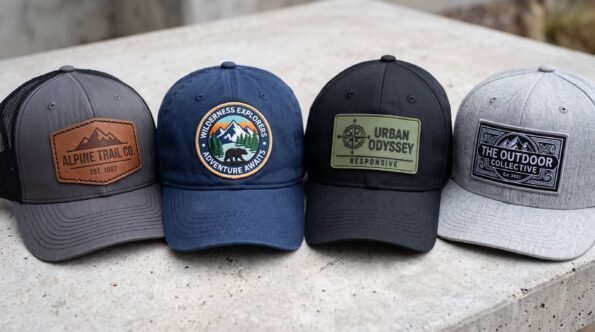
Custom hat patches can turn a simple cap into branded merchandise, team gear, promotional apparel, or a distinctive fashion accessory. A well-designed patch gives your hat a defined visual identity while allowing the same logo or artwork to be used across different headwear styles.
Unlike direct embroidery, a patch is produced separately and then attached to the hat. This makes it easier to create consistent designs across multiple caps and choose different materials, textures, shapes, and attachment methods.
Whether you are customizing a single baseball cap, creating merchandise for a clothing brand, or ordering hats for a team, the key decisions are the same: choose the right patch type, size, backing, and design for your hat.
What Are Custom Hat Patches?
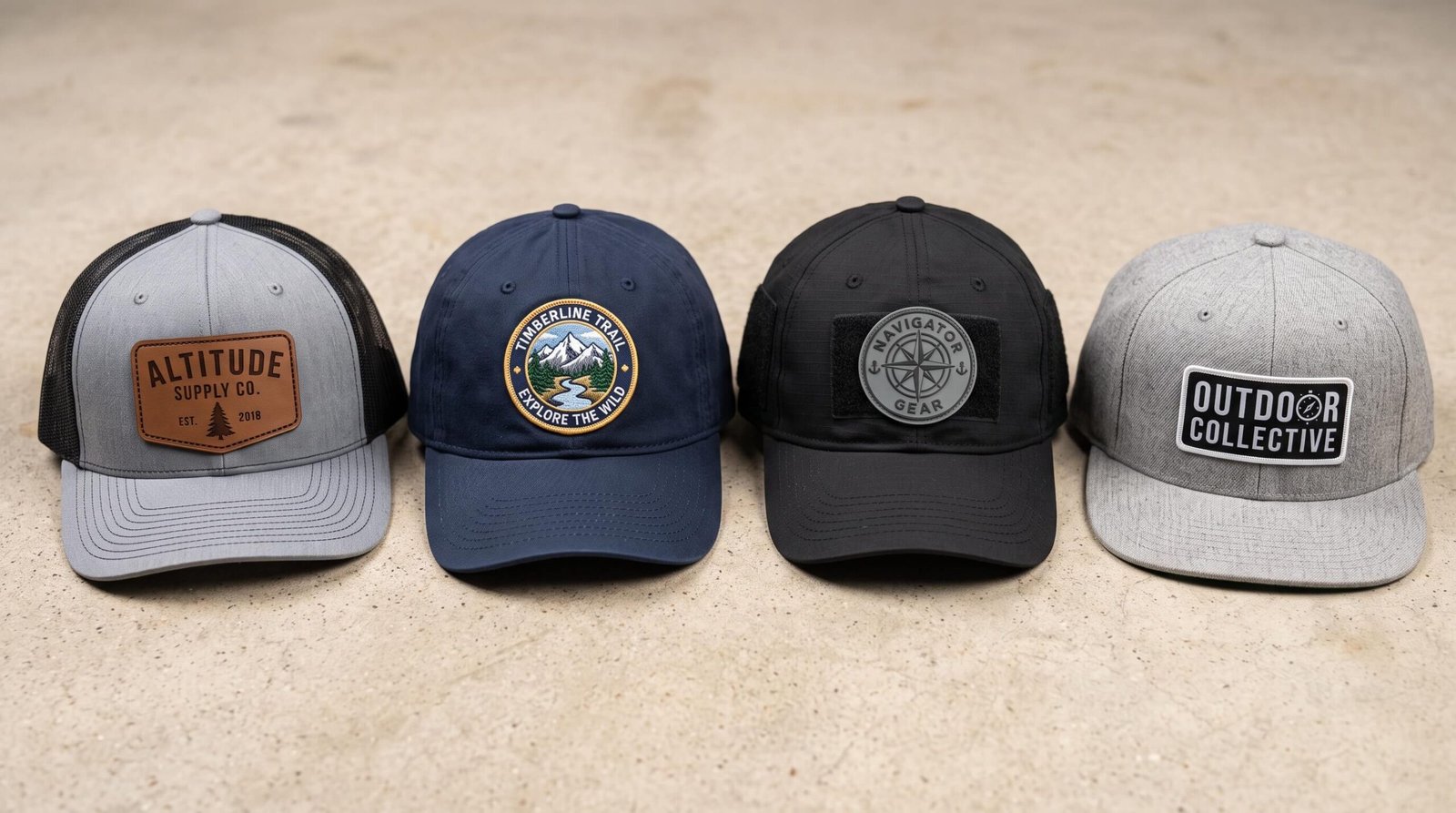
A hat patch is a decorative or branded piece attached to the crown, front panel, side, or another suitable area of a hat. Common materials include embroidered fabric, woven thread, leather, faux leather, PVC, chenille, and printed materials.
Patches are particularly useful when you want a consistent emblem that can be reproduced across multiple hat styles. They can feature company logos, team names, mascots, initials, slogans, artwork, or other custom graphics.
The curved shape of a hat is an important consideration. Unlike a flat garment, a cap has a rounded crown, seams, and limited space. Your patch therefore needs to fit the available panel without interfering with the hat’s construction or making the design difficult to read.
Choose the Right Patch Type for Your Hat
Different patch materials create different visual effects. Your choice should be based on the artwork, desired appearance, hat style, and how the finished hat will be used.
Embroidered Hat Patches
Embroidered patches use stitched thread to create a raised, textured appearance. They are a classic option for baseball caps, snapbacks, team hats, uniforms, and branded merchandise.
They work especially well with bold logos, lettering, mascots, and designs where texture is part of the visual appeal. For a traditional branded cap, embroidery remains one of the most recognizable choices.
Woven Hat Patches
Woven patches have a flatter surface and can reproduce smaller lettering and fine lines more clearly than some traditional embroidered designs.
They are useful for modern logos, detailed wordmarks, minimalist artwork, and fashion brands that want a low-profile finish.
Leather and Faux Leather Patches
Leather patches provide a premium, rugged, or heritage-inspired appearance. They are especially popular on trucker hats, outdoor merchandise, workwear, and lifestyle products.
Genuine leather can develop a natural patina with age, while faux leather provides a similar visual style with different material characteristics. Leather designs generally work best when the artwork uses clean shapes and readable lettering.
PVC Hat Patches
PVC patches have a molded, rubber-like appearance and can create flat or raised details. They are well suited to outdoor, tactical, athletic, and adventure-oriented headwear.
Their molded construction makes them useful when you want a bold design with strong edges and a contemporary appearance.
Chenille Hat Patches
Chenille patches have a soft, raised texture that is strongly associated with varsity and collegiate apparel. They work best with simple shapes, large letters, mascots, and athletic designs.
Because of their thicker texture, they should be sized and positioned carefully on curved hat panels.
Printed Hat Patches
Printed patches can reproduce detailed artwork, gradients, illustrations, and more complex color combinations. They are useful when your design depends on visual details that may not translate effectively into thread or molded materials.
Best Patches for Different Hat Styles
Not every patch works equally well on every type of hat. The crown shape, fabric, panel size, and intended use should all influence your decision.
Trucker Hats
Trucker hats are among the most recognizable patch-style caps. Their structured front panels provide a practical area for logos, badges, and decorative designs.
Leather, embroidered, woven, and printed patches can all work well on trucker hats. The combination of a structured front and mesh back also creates a natural canvas for bold branding.
Baseball Caps
Baseball caps usually have a curved front panel, so patch dimensions should be selected with the crown shape in mind.
Embroidered and woven patches are popular choices for team logos, company branding, clubs, and personal designs. A patch that is too large can crowd the seams or sit awkwardly across the curve.
Snapback Hats
Snapbacks generally have structured front panels that provide a good surface for patches. They are popular for streetwear, sports merchandise, events, and fashion branding.
The patch should be centered according to the shape of the front panel rather than simply choosing a size based on the artwork alone.
Tactical Hats
Tactical hats frequently use hook-and-loop panels, allowing the wearer to change patches when needed. This makes hook-and-loop backing particularly useful for interchangeable identification, morale, flag, team, and organizational patches.
PVC and embroidered patches are common choices when durability and strong visual contrast are priorities.
5-Panel Hats
Five-panel hats often have a flatter uninterrupted front panel, which can provide more flexibility for centered branding. However, the patch should still be proportionate to the panel and avoid crowding the seams.
Beanies and Knit Hats
Beanies have flexible, stretchy surfaces that behave differently from structured caps. Sew-on patches are often a practical option because they avoid exposing delicate knit materials to high heat.
The patch should also remain relatively flexible and appropriately sized so it does not make the beanie uncomfortable to wear.
How to Choose the Right Hat Patch Size
Size is one of the most important factors when designing a patch for a hat. A patch that is too large can overlap seams or distort as the crown curves. One that is too small may make the logo difficult to see.
There is no universal patch size that works for every hat because front-panel dimensions vary. Current hat-patch sizing guides commonly recommend measuring the actual panel before finalizing dimensions. For example, one recent trucker-hat guide recommends designing within approximately 3.5 inches wide by 2.35 inches high as a ceiling for a standard centered patch, rather than treating those dimensions as a required size.
Measure Your Hat Before Ordering
Measure the usable front panel rather than the entire crown. Pay attention to:
- Panel width
- Panel height
- Center seam
- Bill seam
- Crown curvature
- Existing embroidery or decoration
Create a simple paper template using your proposed patch dimensions and place it on the hat. This gives you a quick visual reference before production.
For repeat orders, use the same template and placement measurements to keep every hat consistent.
Consider Hat Curvature
A hat is a three-dimensional surface, so artwork that looks perfect on a flat computer screen may appear different after attachment.
Recent hat-specific design guidance emphasizes accounting for crown curvature, panel seams, and limited flat workspace before production.
For this reason, extremely wide or tall designs should be tested against the actual hat profile before final approval.
Hat Patch Backing Options
The backing determines how your patch attaches and how easily it can be removed or replaced.
Sew-On Backing
Sew-on backing is a dependable choice when you want a permanent attachment. It can work well for baseball caps, trucker hats, beanies, uniforms, and frequently used headwear.
Because the patch is physically stitched to the hat, it can be a good option for products that will experience regular wear.
Iron-On and Heat-Seal Backing
Iron-on or heat-seal backing uses heat to activate an adhesive layer. It can provide convenient application on compatible fabrics.
However, hats can be more challenging than flat garments because of their curved construction. Heat needs to reach the adhesive evenly, and excessive heat may damage some fabrics or finishes. For hats that receive heavy wear, edge stitching can provide additional reinforcement.
Hook-and-Loop / Velcro Backing
Hook-and-loop backing allows a patch to be removed and replaced. It is particularly useful when the hat already has a loop panel.
This option is popular for tactical hats, interchangeable identification, morale patches, organizational patches, and users who want to change designs regularly.
Adhesive Backing
Self-adhesive backing can be useful for temporary applications, displays, samples, or projects where sewing and heat application are not appropriate.
For permanent headwear, however, select the backing according to the hat fabric and expected level of wear.
How to Design a Hat Patch That Stands Out
A strong patch starts with a design that remains recognizable at a relatively small size.
Keep Logos Clear
Avoid unnecessary details that become difficult to reproduce at patch scale. A strong silhouette and readable lettering usually perform better than an overcrowded design.
If your logo contains very small text, consider whether a woven or printed construction would reproduce it more clearly.
Use Strong Color Contrast
Your patch should stand out from the hat without looking disconnected from it. Consider the relationship between the patch background, border, lettering, and hat color.
A dark patch on a dark hat may lose visual impact, while a high-contrast border can help define the design.
Simplify Small Details
Fine lines and tiny lettering can become difficult to reproduce in embroidery. Simplifying the artwork or selecting a patch construction designed for finer detail can improve the final result.
Match the Patch to the Hat
Think about the personality of the finished product.
A leather patch may suit an outdoor or heritage brand. An embroidered patch may work for a sports team or traditional logo. PVC can create a modern tactical or performance aesthetic, while woven patches can provide a clean, low-profile appearance.
Custom Hat Patches for Brands, Teams & Businesses
Hats are valuable promotional and merchandise products because the branding remains visible while the item is worn.
Clothing and Fashion Brands
Fashion labels can use patches to place logos, collection names, symbols, and artwork on trucker hats, snapbacks, baseball caps, and other headwear.
A consistent patch design can also become a recognizable brand asset across multiple collections.
Sports Teams and Clubs
Teams can create patches featuring mascots, names, numbers, championships, or organizational logos. These can be used on player caps, coaching hats, fan merchandise, and event apparel.
Outdoor and Lifestyle Brands
Outdoor companies, adventure groups, fishing brands, hiking organizations, and lifestyle businesses often benefit from rugged patch materials such as leather or PVC.
Corporate and Promotional Hats
Businesses can add company logos or campaign artwork to hats used as employee apparel, promotional merchandise, event giveaways, or customer gifts.
For larger orders, maintaining consistent dimensions, colors, artwork, and placement is particularly important.
How to Order Custom Hat Patches
Ordering your patch starts with your artwork and the hat you plan to use.
1. Prepare Your Artwork
Submit your logo, graphic, text, or design concept. Vector artwork is generally ideal because it can be scaled without losing quality.
2. Choose the Patch Material
Select embroidered, woven, leather, PVC, chenille, printed, or another suitable construction based on your artwork and desired appearance.
3. Measure the Hat
Identify the usable panel and determine the maximum patch dimensions that fit comfortably without covering seams.
4. Select the Backing
Choose sew-on, heat-seal, hook-and-loop, or another backing according to the hat material and whether the patch should be permanent or removable.
5. Review the Proof
Before production, review the proposed size, shape, colors, lettering, border, and overall proportions. A digital proof helps identify problems before manufacturing.
6. Approve Production
Once the artwork and specifications are confirmed, approve the design for production.
For larger brand, team, or promotional orders, keep the approved artwork and specifications available for future repeat orders. This helps maintain consistent branding across different production runs.
Create a Hat Patch That Fits
The best patch is not necessarily the largest or most detailed option. It is the one that fits the hat’s usable surface, reproduces the artwork clearly, complements the hat style, and uses an attachment method suited to the intended use.
From trucker and baseball caps to snapbacks, tactical hats, 5-panel caps, and beanies, the right combination of material, size, design, and backing can turn ordinary headwear into distinctive branded merchandise.
Start with your artwork, measure the hat, choose the patch style that fits your design, and review the final proof before production. With the right specifications, your patch can achieve a clean, recognizable finish that’s perfect for personal projects, teams, businesses, and clothing brands at Patches Order.
| Patch Type | Best For | Detail | Look |
|---|---|---|---|
| Embroidered | Baseball caps, teams, brands | Medium | Textured |
| Woven | Detailed logos, fashion | High | Flat |
| Leather | Trucker, outdoor, lifestyle | Medium–High | Premium/rugged |
| PVC | Tactical, outdoor, sports | High | Modern/3D |
| Chenille | Varsity, sports | Low–Medium | Soft/raised |
| Printed | Detailed artwork, gradients | Very high | Flat/full-color |
FAQs About Custom Hat Patches
What are the best patches for hats?
The right patch depends on the hat style and the look you want. Embroidered patches are a great all-purpose option for baseball caps, while leather patches suit trucker and lifestyle hats. Woven patches work well for detailed artwork, and PVC patches are a durable choice for tactical and outdoor hats.
What size should a patch be for a hat?
The ideal patch size depends on the available space on the hat’s front panel. Measure the area between the seams and consider the shape and curve of the crown before choosing a size. A patch should be large enough to display the design clearly without overwhelming the hat.
What type of patch is best for a trucker hat?
Trucker hats can work well with embroidered, leather, woven, and printed patches. Leather creates a rugged and premium appearance, while embroidered patches add a traditional textured finish. Woven patches are a good option when your design includes smaller details or text.
Can you put an iron-on patch on a hat?
Yes, an iron-on patch can be applied to some hats, provided the fabric and construction can safely handle heat. However, the curved shape of a cap can make it harder to apply consistent heat and pressure. For hats that receive frequent use, sewing the patch in place can provide additional durability.
Are Velcro patches good for tactical hats?
Yes. Hook-and-loop patches are especially practical for tactical hats that have a loop panel. They allow you to change designs whenever needed without permanently attaching the patch, making them useful for interchangeable logos, identification patches, and different applications.
Are embroidered or woven patches better for hats?
Both options work well, but they create different results. Embroidered patches have a raised, textured finish that suits bold logos and traditional designs. Woven patches have a smoother surface, which makes them better suited to fine lines, small lettering, and designs that require greater visual detail.
How do I make sure my hat patch looks professional?
Start by measuring the usable area of the hat and selecting a size that fits naturally within the front panel. Keep the artwork clear, avoid unnecessary fine details, and choose colors that contrast well with the hat. The backing should also match how the hat will be used. Before production, reviewing a digital proof or testing the size with a paper template can help confirm that the final patch will look balanced.
