When ordering a custom embroidered patch, you may come across three options:
- 50% embroidery coverage
- 75% embroidery coverage
- 100% embroidery coverage
At first, it can sound like a quality scale.
It is not.
A 100% embroidered patch is not automatically better than a 75% or 50% embroidered patch.
The percentage simply describes how much of the visible patch surface is covered with embroidery thread and how much of the base fabric remains visible.
That difference can change the patch’s:
- Appearance
- Texture
- Weight
- Flexibility
- Stitch density
- Background treatment
- Production requirements
- Overall style
The right embroidery coverage depends mainly on your artwork and the look you want to achieve.
This guide explains exactly how 50%, 75%, and 100% embroidery coverage differ and how to choose the appropriate level for your custom patch.
If you already know you want a traditional stitched patch, explore Custom Embroidery Patches from PatchesOrder.
What Is Embroidery Coverage?
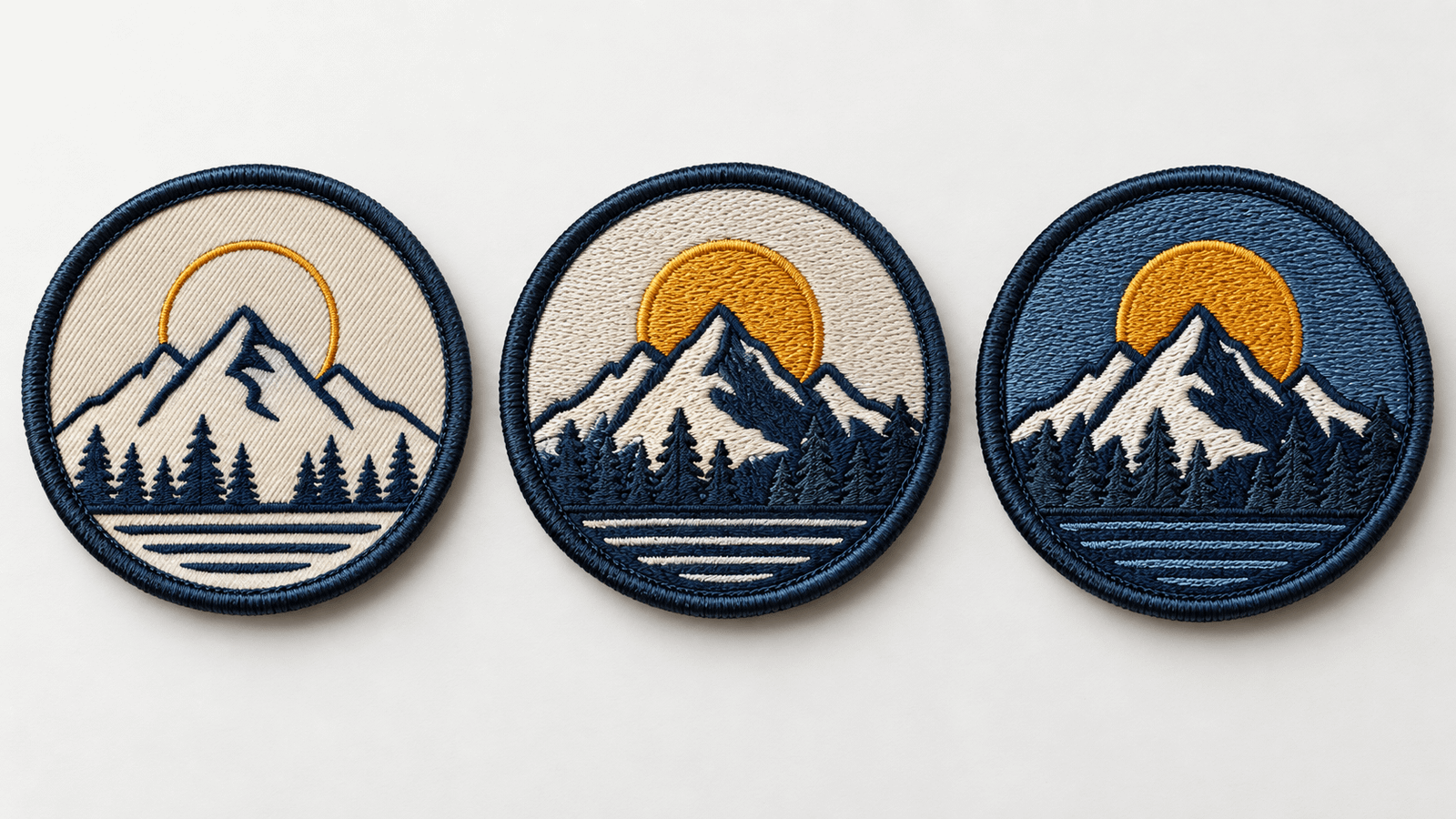
Embroidery coverage refers to the approximate percentage of the patch face that is covered with embroidery thread.
The remaining area usually shows the underlying fabric, commonly a twill or similar base material.
Think of the patch surface as a canvas.
If embroidery covers roughly half of that canvas while the remaining background is visible fabric, the design falls around the 50% coverage category.
If most of the patch is stitched but some fabric remains visible, it is closer to 75% coverage.
If embroidery covers essentially the entire visible face, it is considered 100% embroidery coverage.
The percentages are best understood as production categories rather than something you need to calculate precisely yourself.
Your artwork determines how much of the surface actually requires stitching.
50%, 75% and 100% Embroidery at a Glance
| Coverage | Visible Base Fabric | Overall Look | Works Well For |
|---|---|---|---|
| 50% | A large amount | Open, lighter, traditional | Simple logos, text, large solid backgrounds |
| 75% | Some | Balanced and textured | Company logos, badges, uniforms, general branding |
| 100% | Little to none | Fully stitched, dense, dimensional | Premium-looking emblems, detailed backgrounds, full-thread designs |
The important question is not:
Which percentage is the highest?
Instead ask:
How much of my design actually needs to be embroidered?
What Does 50% Embroidery Coverage Mean?
A 50% embroidered patch leaves a substantial amount of the base fabric visible.
The thread is concentrated on important design elements such as:
- Logo
- Text
- Symbols
- Borders
- Numbers
- Emblems
while larger background areas can remain unstitched.
For example, imagine a navy patch with:
- A white company name
- A small red symbol
- A white embroidered border
If the navy background can simply be created using navy base fabric, there may be no reason to cover that entire background with navy thread.
The exposed fabric becomes part of the design.
What Does a 50% Embroidered Patch Look Like?
A 50% coverage patch usually looks more open.
You can clearly see the difference between:
- The smooth base material
- The raised embroidered elements
That contrast can actually create an attractive traditional patch appearance.
It is especially effective when the background is a single solid color.
When Does 50% Coverage Make Sense?
Consider approximately 50% embroidery coverage when the design contains:
- Large plain background areas
- Bold lettering
- Simple logos
- Limited graphic elements
- One dominant background color
- Minimalist artwork
Examples might include:
WORK CREW
embroidered in white over black twill.
Or:
A simple mountain symbol and business name over a navy base.
In both cases, fully stitching the entire background may add embroidery without significantly changing the visual message.
Advantages of 50% Embroidery Coverage
Strong Fabric-and-Thread Contrast
The base fabric becomes a visible part of the patch instead of simply being hidden underneath embroidery.
Less Dense Construction
With more exposed fabric, the patch can have a lighter and less fully stitched feel.
Works Well for Simple Designs
Clean logos and bold text often do not need complete surface coverage.
Efficient Use of Embroidery
Thread is concentrated where it contributes most to the design.
When 50% Coverage May Not Be Ideal
Lower coverage may not create the appearance you want if:
- The background itself contains artwork.
- You want a completely stitched surface.
- Multiple background colors are required.
- A rich, dense embroidered texture is central to the design.
- Exposed fabric would interrupt the intended artwork.
In those situations, 75% or 100% coverage may be more appropriate.
What Does 75% Embroidery Coverage Mean?
A 75% embroidered patch uses thread across most of the visible surface while still leaving selected areas of the underlying fabric exposed.
It sits between the open appearance of 50% coverage and the fully stitched look of 100%.
This makes it particularly versatile.
A design can retain visible fabric where it makes sense while using embroidery throughout the major visual elements.
What Does 75% Coverage Look Like?
At this level, embroidery becomes the dominant visual feature.
You still may see base material in:
- Background areas
- Negative space
- Open sections around lettering
- Selected parts of the design
but most of the patch has a stitched texture.
This can create a balanced appearance without covering every part of the surface simply for the sake of reaching 100%.
When Does 75% Coverage Make Sense?
Approximately 75% coverage works well for designs containing:
- Medium-complexity logos
- Multiple embroidered elements
- Prominent lettering
- Detailed badges
- Organization emblems
- Sports logos
- Club designs
- Corporate branding
It can also work well when the exposed base fabric intentionally serves as one of the design colors.
Why 75% Coverage Is a Useful Middle Ground
Imagine a circular company patch.
The design includes:
- Company name around the edge
- Large embroidered logo in the center
- Embroidered outer border
- Several small graphic details
but a simple black background remains between those elements.
That background could remain visible twill while the important parts receive embroidery.
The result can still look heavily embroidered without needing thread across every square inch of the patch.
What Does 100% Embroidery Coverage Mean?
A 100% embroidered patch has embroidery covering essentially the entire visible face of the patch.
Instead of using exposed base fabric as part of the visible design, thread forms both:
- Foreground elements
- Background areas
This creates the dense, fully stitched appearance many people associate with traditional premium embroidered emblems.
What Does a 100% Embroidered Patch Look Like?
The patch surface appears almost entirely made from thread.
You see embroidered texture across:
- Logos
- Text
- Symbols
- Background
- Decorative areas
Very little or no base fabric is intentionally left visible on the face.
This gives the patch a richer and more dimensional texture.
When Does 100% Embroidery Make Sense?
Full coverage can work particularly well when:
- The entire background should have stitched texture.
- Artwork contains several background color areas.
- The design depends heavily on embroidery as a visual element.
- You want a dense, traditional embroidered appearance.
- Exposed twill would look inconsistent with the design.
For example, imagine a detailed shield patch with:
- Red embroidered background
- White lettering
- Gold symbol
- Black accent areas
- Embroidered border
If essentially every part of the visible face is intended to appear stitched, 100% coverage makes sense.
50% vs. 75% vs. 100% Embroidery Coverage
Here is the practical difference:
| Feature | 50% | 75% | 100% |
|---|---|---|---|
| Base fabric visibility | High | Moderate | Very little / none |
| Embroidered texture | Selective | Dominant | Full surface |
| Visual density | Light | Medium-high | High |
| Background | Often fabric | Fabric + thread | Usually embroidered |
| Simple logos | Excellent | Excellent | Possible |
| Complex embroidered background | Limited | Good | Excellent |
| Flexible open appearance | Strong | Balanced | Dense |
| Fully stitched look | No | Partial | Yes |
None of these is inherently the “best.”
The artwork decides.
Embroidery Coverage Is Not a Quality Rating
One of the most important things to understand is:
50% does not mean 50% quality.
And:
100% does not mean twice the quality of 50%.
Coverage describes construction.
A professionally made 50% patch using the base fabric intelligently can look better than a 100% patch that contains unnecessary stitching.
Likewise, a design intended to have a fully embroidered background may look incomplete at lower coverage.
The goal should be to match the embroidery percentage to the artwork rather than automatically choosing the highest number.
Use the Base Fabric as Part of the Design
One of the easiest ways to understand embroidery coverage is to stop thinking of the fabric underneath as something that always needs to be hidden.
The fabric can function as a design color.
Imagine your logo requires:
- Black background
- White letters
- Red icon
Instead of embroidering a large black background, black twill can potentially provide that visual area while white and red thread form the foreground.
This approach can work especially well with:
- Simple company patches
- Name patches
- Uniform emblems
- Text-based designs
- Minimal logos
The base fabric becomes intentional negative space.
Does More Embroidery Make a Patch Thicker?
Generally, increasing the amount of stitched surface can give a patch a denser and more substantial feel because more thread is being placed across the patch face.
However, finished thickness also depends on:
- Thread
- Stitch type
- Stitch density
- Base fabric
- Backing
- Border
- Patch dimensions
- Artwork
Do not choose 100% coverage only because you assume thicker always means better.
The patch still needs to suit the garment or item where it will be used.
Does Embroidery Coverage Affect Flexibility?
It can.
A patch with significant exposed fabric may feel somewhat more flexible than a similarly constructed patch whose entire surface is densely stitched.
This may matter for patches used on:
- Shirts
- Lightweight apparel
- Curved surfaces
- Hats
- Flexible garments
A large fully embroidered design can behave differently from a smaller, more open patch.
For clothing applications, browse Custom Clothing Patches to compare patch styles suited to shirts, jackets, uniforms, workwear, and other apparel.
Does Embroidery Coverage Affect Price?
Embroidery coverage can influence production requirements because higher coverage generally involves more stitching across the patch surface.
But coverage should not be viewed as the only pricing factor.
The final quote may also depend on:
- Patch size
- Quantity
- Artwork
- Shape
- Backing
- Design complexity
- Other customization requirements
So while a 100% embroidered version of the same design can require more stitching than a lower-coverage version, you should quote the actual project rather than trying to calculate price from embroidery percentage alone.
Does 100% Embroidery Mean More Detail?
Not necessarily.
Coverage and detail are different concepts.
Coverage = how much of the patch surface contains stitching.
Detail = how precisely the artwork reproduces small lines, letters, shapes, and graphics.
A 100% embroidered patch can still contain relatively simple artwork.
Meanwhile, a 50% embroidered patch could contain detailed lettering in the areas that are stitched.
If your design contains particularly small text or fine graphic details, another construction may sometimes be more suitable.
Custom Woven Patches use finer woven threads and provide a smoother surface that works well for small lettering and intricate logos.
Our Woven vs. Embroidered Patches comparison explains this difference in more detail.
50% Embroidery Example
Imagine a rectangular mechanic name patch.
The design contains:
- Black twill background
- White embroidered name
- Red embroidered border
Most of the center background remains black fabric.
Only the name and border require substantial stitching.
This is a good example of a design where lower embroidery coverage can make visual sense.
Covering the black fabric with black embroidery may not add enough visual value to justify changing the construction.
75% Embroidery Example
Imagine a sports team emblem containing:
- Large embroidered mascot
- Team name
- Outer embroidered border
- Two supporting graphic elements
- Small amount of visible background
Most of the patch is stitched, but a portion of the base still contributes to the design.
That is the type of artwork that may naturally fall into a medium or higher coverage range.
100% Embroidery Example
Imagine a circular club emblem where the entire visible surface includes:
- Embroidered background
- Large central logo
- Circular lettering
- Decorative details
- Contrasting outer border
There is essentially no intentional open fabric area.
This design naturally lends itself to full embroidery coverage.
Which Coverage Is Best for Logo Patches?
Start by looking at the background of your logo.
Choose Lower Coverage When:
Your design has:
- Large plain background
- Limited colors
- Simple text
- Small central logo
The background fabric itself may be able to provide much of the required color.
Consider 75% Coverage When:
Your design contains:
- Larger embroidered logo
- Several stitched elements
- Text around the design
- Some usable open background
This gives you a highly embroidered appearance while retaining selected fabric areas.
Consider 100% Coverage When:
Your design requires:
- Embroidered background texture
- Multiple stitched background areas
- Dense visual treatment
- Full thread appearance
The logo should determine the coverage—not the other way around.
Which Coverage Is Best for Uniform Patches?
Uniform patches often use:
- Organization name
- Department
- Logo
- Shield
- Badge
- Unit identifier
A simple uniform emblem can work effectively with visible twill in the background.
A more elaborate badge-style design may require higher coverage.
Rather than automatically selecting 100%, consider:
- How much background is plain?
- Does that background need embroidered texture?
- Is the base fabric already available in the correct color?
- Which elements actually need thread?
That approach keeps the patch visually purposeful.
Which Coverage Is Best for Hat Patches?
Hat patches have limited space.
That means patch dimensions, artwork clarity, and flexibility can matter as much as coverage.
A simple embroidered logo on a fabric background may not need full coverage.
A heavily stitched badge may use higher coverage if the design requires it.
Because caps are curved, avoid adding thread simply to reach a particular percentage.
The finished patch still needs to sit naturally on the hat.
For more headwear-specific guidance, read our Custom Hat Patches Guide.
Which Coverage Is Best for Jacket Patches?
Jackets can support a wide range of embroidered styles.
A small chest logo may use lower or medium coverage.
A prominent club emblem or large back patch may use a much greater amount of embroidery if the artwork calls for a fully stitched appearance.
Large patches deserve particular attention because increasing both:
- Patch dimensions
- Embroidery coverage
can significantly increase the total amount of stitching.
Design the background intentionally rather than automatically filling every area.
Does 100% Coverage Hide the Base Fabric?
Yes. The purpose of full embroidery coverage is for thread to cover essentially the visible patch face rather than intentionally exposing substantial background fabric.
The base still plays a structural role beneath the embroidery, but it is not intended to become a major visible element of the finished design.
This is why 100% embroidery produces such a distinctive thread-rich appearance.
Does 50% Coverage Look Unfinished?
No.
A properly designed 50% embroidered patch should look intentional.
The visible base fabric is part of the design.
Problems occur when a design intended for full coverage is incorrectly produced with large unexpected blank areas.
That is different from deliberately using exposed fabric as a background.
A strong 50% design uses the fabric purposefully.
Should Background Areas Always Be Embroidered?
No.
Ask whether stitching the background improves the patch.
If your design simply requires a solid navy field and navy base fabric already creates the correct appearance, embroidering navy thread over the same area may not be necessary.
On the other hand, if you specifically want:
- Stitched texture
- Multiple background colors
- Directional thread effects
- Dense embroidered appearance
then embroidering the background may be important.
Coverage vs. Stitch Density: They Are Not the Same Thing
These terms can be confused.
Embroidery coverage describes how much of the overall patch surface contains embroidery.
Stitch density relates more closely to how tightly stitches are placed within embroidered areas.
You could theoretically have:
- A patch with embroidery across a smaller portion of its surface
- But dense stitching within those embroidered sections
Coverage should therefore be discussed as a design-area decision, not simply as a measure of how tightly stitched the patch is.
Coverage vs. Thread Colors
More colors do not automatically mean higher coverage.
A 50% patch might use:
- Five thread colors
while a 100% patch might use:
- Only two thread colors
Coverage measures surface area, not color count.
Similarly, a design containing many colors does not automatically need the entire patch face embroidered.
Look at both factors separately.
Coverage vs. Patch Size
A small 100% embroidered patch and a large 100% embroidered patch do not require the same amount of thread.
Percentage is relative to the patch surface.
For example:
100% of a 2-inch patch is very different from 100% of a 10-inch jacket-back patch.
This is why embroidery percentage should never be considered independently from the physical dimensions.
How Artwork Influences Embroidery Coverage
Before choosing coverage, inspect the artwork.
Look for four things.
1. Background
Can one solid base fabric color create the background?
If yes, lower coverage may work.
2. Foreground Elements
How much space do the logo, text, symbols, and graphics occupy?
The more visual elements you have, the higher the natural embroidery percentage may become.
3. Negative Space
Does open background improve the composition?
Do not fill useful negative space with embroidery simply to increase coverage.
4. Texture
Does the artwork need thread texture across the whole design?
If yes, higher coverage may be appropriate.
A Simple Way to Choose Embroidery Coverage
Use this three-question test.
Can the Base Fabric Become the Background?
Yes: Start by considering 50% or 75%.
No: Higher coverage may make more sense.
Does Most of the Patch Contain Actual Artwork?
No: Lower coverage may be sufficient.
Yes: Consider 75% or 100%.
Question 3: Do You Specifically Want a Fully Stitched Surface?
No: Do not choose 100% just because the number sounds better.
Yes: Full coverage is likely the appropriate direction.
Common Embroidery Coverage Mistakes
Assuming 100% Automatically Means Better Quality
Coverage is a design specification, not a quality score.
Embroidering a Solid Background Unnecessarily
If the base fabric can already provide the correct color and appearance, consider whether extra stitching adds anything meaningful.
Choosing Coverage Before Reviewing the Artwork
The artwork should determine the percentage.
Confusing Coverage With Detail
A fully embroidered patch does not automatically reproduce finer details.
Ignoring Patch Size
High coverage on a large patch involves much more stitching than high coverage on a small one.
Ignoring the Final Application
Think about whether the patch will go on:
- Shirt
- Hat
- Jacket
- Uniform
- Backpack
- Workwear
The feel and flexibility of the finished patch should suit the item.
Can You Tell Embroidery Coverage From Artwork Alone?
Often, an experienced patch designer can estimate the appropriate coverage after seeing your artwork.
You usually do not need to calculate percentages yourself.
Provide the actual design and explain the appearance you want.
PatchesOrder accepts your own logo, artwork, image, or design concept and prepares a digital proof before the custom product moves into production.
That proof gives you an opportunity to review the design before approval.
How to Make Your Embroidered Patch Look Better at Any Coverage
The most effective patch is not necessarily the one with the most thread.
Focus instead on:
- Clear logo structure
- Readable text
- Appropriate dimensions
- Good color contrast
- Clean borders
- Useful negative space
- Suitable backing
- Balanced proportions
If those fundamentals are correct, 50%, 75%, or 100% coverage can all produce excellent results.
When Embroidery May Not Be the Best Option
Embroidery is known for its raised, traditional stitched appearance.
But not every design is ideally suited to that texture.
If your artwork depends heavily on:
- Extremely fine lines
- Very small lettering
- Intricate details
- A smooth surface
consider Custom Woven Patches.
If you want a molded, rubber-like appearance for outdoor or tactical applications, explore Custom PVC Patches.
You can browse all available materials through Custom Patches.
50%, 75% or 100%: Which Should You Choose?
Here is the simplest answer.
Choose Approximately 50% Embroidery When:
- Your design is relatively simple.
- Large areas can remain base fabric.
- The fabric background is intentionally part of the design.
- Embroidery is concentrated on the logo, lettering, and border.
Choose Approximately 75% Embroidery When:
- Embroidery should dominate the visual appearance.
- Your artwork contains several stitched elements.
- Some base fabric can still remain visible.
- You want a balance between thread texture and exposed background.
Choose 100% Embroidery When:
- You want the entire visible surface stitched.
- The background itself needs embroidery.
- The design uses multiple stitched background elements.
- A dense thread-rich appearance is part of the intended style.
The best coverage level is the one that reproduces your artwork properly.
Not the one with the largest number.
Create Custom Embroidered Patches With the Right Coverage
A well-designed embroidered patch uses thread where it contributes to the artwork.
Sometimes that means covering approximately half of the patch.
Sometimes it means covering most of it.
And sometimes the design calls for embroidery across the entire visible surface.
Start with the artwork rather than the percentage.
Then consider:
- Intended application
- Patch dimensions
- Background color
- Text
- Design complexity
- Desired texture
- Backing
Explore Custom Embroidery Patches to create a traditional stitched patch using your own logo, artwork, text, or emblem.
If you are still comparing materials, browse all Custom Patches or read Woven vs. Embroidered Patches to understand when a smoother woven construction may suit detailed artwork better.
For patches intended specifically for shirts, jackets, uniforms, workwear, or branded apparel, visit Custom Clothing Patches.
Ready to turn your artwork into a custom patch?
Request a Free Quote from PatchesOrder.
Frequently Asked Questions About Embroidery Coverage
What does embroidery coverage mean on a patch?
Embroidery coverage describes approximately how much of the visible patch surface is covered with embroidery thread instead of exposed base fabric.
What is 50% embroidery coverage?
Approximately 50% coverage means a substantial part of the visible patch remains base fabric while embroidery is used for elements such as lettering, logos, symbols, and borders.
What is 75% embroidery coverage?
Approximately 75% coverage means most of the patch surface contains embroidery, while some areas of the underlying fabric remain intentionally visible.
What is 100% embroidery coverage?
100% embroidery coverage means thread covers essentially the entire visible face of the patch, including background areas.
Is 100% embroidery better than 75%?
Not automatically. The correct coverage depends on the artwork. If exposed fabric works naturally as the background, 75% coverage may produce a cleaner design without unnecessary stitching.
Is 50% embroidery low quality?
No. Embroidery percentage is not a quality rating. A 50% embroidered patch intentionally uses visible base fabric as part of its design.
Does embroidery coverage affect patch price?
It can because greater coverage usually requires stitching across more of the patch surface. However, size, quantity, artwork, backing, shape, construction, and other customization requirements can also affect the final quote.
Does 100% embroidery mean the patch has more detail?
No. Coverage describes how much surface area is embroidered, not how detailed the artwork is. Detail depends on factors such as design complexity, thread construction, dimensions, and manufacturing method.
Are 100% embroidered patches thicker?
A fully embroidered surface generally creates a denser thread texture than a comparable patch with substantial exposed fabric, although overall thickness also depends on the base, stitches, backing, border, and construction.
Is 50% embroidery good for logo patches?
Yes, particularly when the logo is relatively simple and the base fabric can provide a large solid background color.
Which coverage is best for uniform patches?
It depends on the emblem. Simple text or logos may work with lower coverage, while complex badge-style designs or fully stitched backgrounds may require higher coverage.
Which coverage is best for hats?
There is no universal percentage for hats. Choose coverage according to the artwork, patch dimensions, desired texture, and how the patch will sit on the curved hat surface.
Should I choose 100% embroidery for a premium look?
Choose 100% when a fully stitched surface supports the intended visual style. Do not add full background embroidery solely because 100% sounds more premium.
Can PatchesOrder help determine embroidery coverage?
Submit your logo or artwork with your custom patch requirements. The design can be reviewed and a digital proof prepared before production so you can confirm how the finished embroidered patch will look.
